
|
You entered: nearest stars
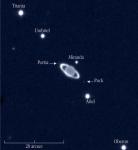 Ringed Planet Uranus
15.01.2003
Yes it does look like Saturn, but Saturn is one of only four giant ringed planets in our Solar System. And while Saturn has the brightest rings, this system of rings and moons actually belongs to planet Uranus, imaged here in near-infrared light by the Antu telescope at the ESO Parnal Observatory in Chile.
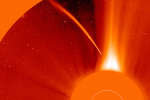 Sungrazer
22.03.2009
The Sun destroyed this comet. Arcing toward a fiery fate, this Sungrazer comet was recorded by the SOHO spacecraft's Large Angle Spectrometric COronagraph(LASCO) on 1996 Dec. 23. LASCO uses an occulting disk...
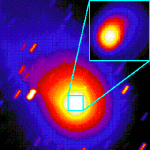 Periodic Comet Swift-Tuttle
19.02.1996
Comet Swift-Tuttle, shown above in false color, is the largest object known to make repeated passes near the Earth. It is also one of the oldest known periodic comets with sightings spanning two millennia.
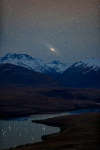 Andromeda in Southern Skies
21.10.2022
Looking north from southern New Zealand, the Andromeda Galaxy never gets more than about five degrees above the horizon. As spring comes to the southern hemisphere, in late September Andromeda is highest in the sky around midnight though.
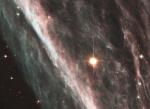 APOD: 2003 June 9 Ш The Pencil Nebula Supernova Shockwave
9.06.2003
At 500,000 kilometers per hour, a supernova shockwave plows through interstellar space. This shockwave is known as the Pencil Nebula, or NGC 2736, and is part of the Vela supernova remnant, an expanding shell of a star that exploded about 11,000 years ago.
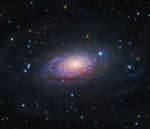 Messier 63: The Sunflower Galaxy
12.07.2017
A bright spiral galaxy of the northern sky, Messier 63 is about 25 million light-years distant in the loyal constellation Canes Venatici. Also cataloged as NGC 5055, the majestic island universe is nearly 100,000 light-years across. That's about the size of our own Milky Way Galaxy.
 38 Hours in the M81 Group
10.04.2025
From a garden on planet Earth, 38 hours of exposure with a camera and small telescope produced this cosmic photo of the M81 galaxy group. In fact, the group's dominant galaxy M81 is near the center of the frame sporting grand spiral arms and a bright yellow core.
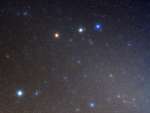 Stars and Mars
10.05.2008
Wandering through the evening sky, on May 4th planet Mars stood in line with Castor and Pollux, the two bright stars of the constellation Gemini. In this time exposure of the celestial alignment, Mars...
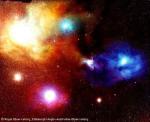 Antares and Rho Ophiuchi
9.05.2004
Why is the sky near Antares and Rho Ophiuchi so colorful? The colors result from a mixture of objects and processes. Fine dust illuminated from the front by starlight produces blue reflection nebulae. Gaseous clouds whose atoms are excited by ultraviolet starlight produce reddish emission nebulae. Backlit dust clouds block starlight and so appear dark.
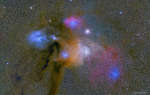 Colorful Clouds Near Rho Ophiuchi
6.07.2015
Why is the sky near Antares and Rho Ophiuchi so colorful? The colors result from a mixture of objects and processes. Fine dust illuminated from the front by starlight produces blue reflection nebulae. Gaseous clouds whose atoms are excited by ultraviolet starlight produce reddish emission nebulae. Backlit dust clouds block starlight and so appear dark.
|
January February March April May June July August September |
|||||||||||||||||||||||||||||||||||||||||||||||||