
|
You entered: planets
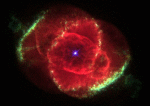 The Cat's Eye Nebula (Revisited)
4.07.1996
Three thousand light years away, a dying star throws off shells of glowing gas. This image from the Hubble Space Telescope reveals "The Cat's Eye Nebula" to be one of the most complex planetary nebulae known.
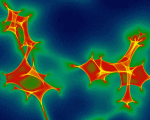 A Network of Microlensing Caustics
15.12.2002
A virtual sky map like this would be of interest to astronomers studying gravitational microlensing. In microlensing, the gravity of stars near the line of sight can act to magnify the light of background objects such as distant stars, or quasars. Nowhere is this magnification greater than near a gravitational lensing caustic.
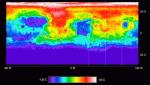 Thermal Mars
2.06.1999
It's 2 AM on Mars and surface temperatures range from -65C to -120C, as measured by the Thermal Emission Spectrometer (TES) onboard the Mars Global Surveyor spacecraft. TES data used...
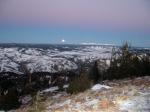 Shadow Set
4.02.2006
A nearly full Moon and planet Earth's shadow set together in this scene captured on January 13th from snowy Mt. Jelm, home of the Wyoming Infrared Observatory. For early morning risers (and late...
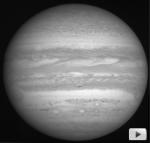 Watch Jupiter Rotate
12.03.2007
What would it be like to coast by Jupiter and watch it rotate? This was just the experience of the New Horizons spacecraft as it approached and flew by Jupiter earlier this year. Clicking on the image will bring up a movie of what the robotic spacecraft saw.
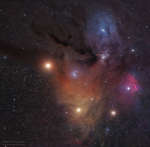 Mars in the Clouds
8.09.2016
Wandering through this stunning field of view, Mars really is in front of these colorful cosmic clouds. The mosaic contructed from telescopic images is about 5 degrees (10 full moons) across. It captures...
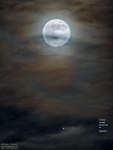 Moons and Jupiter
13.04.2017
On April 10, a Full Moon and Jupiter shared this telephoto field of view. Both were near opposition, opposite the Sun in Earth's night sky. Captured when a passing cloud bank dimmmed...
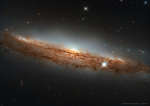 NGC 3717: A Nearly Sideways Spiral Galaxy
12.11.2019
Some spiral galaxies are seen nearly sideways. Most bright stars in spiral galaxies swirl around the center in a disk, and seen from the side, this disk can be appear quite thin. Some spiral galaxies appear even thinner than NGC 3717, which is actually seen tilted just a bit.
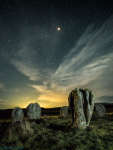 Mars over Duddo Stone Circle
23.03.2021
Why are these large stones here? One the more famous stone circles is the Duddo Five Stones of Northumberland, England. Set in the open near the top of a modest incline, a short hike across empty fields will bring you to unusual human -sized stones that are unlike anything surrounding them.
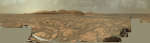 Curiosity: Sol 3048
25.03.2021
Before Perseverance there was Curiosity. In fact, the Curiosity rover accomplished the first sky crane maneuver touchdown on Mars on April 5, 2012. March 2, 2021 marked Curiosity's 3,048th martian day operating on the surface of the Red Planet.
|
January February March April May June July August September October |
|||||||||||||||||||||||||||||||||||||||||||||||||