
|
You entered: sky
 APOD: 2025 May 5 Б Planet Lines Across Water
5.05.2025
WhatБs causing those lines? Objects in the sky sometimes appear reflected as lines across water Б but why? If the waterБs surface is smooth, then reflected objects would appear similarly -- as spots.
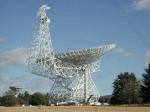 The 100 Meter Green Bank Radio Telescope
11.03.2002
The largest single-dish fully steerable radio telescope began operation in 2000 August in Green Bank, West Virginia, USA. Dedicated as the Robert C. Byrd Green Bank Telescope, the device weighs over 30 times more than the Statue of Liberty, and yet can point anywhere in the sky more precisely than one thousandth of a degree.
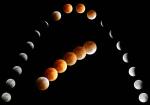 A Lunar Eclipse Mosaic
6.05.2004
From start to finish, this impressive digital mosaic covers May 4th's total eclipse of the Moon. Astronomer Anthony Ayiomamitis reports that the eclipse viewing was wonderful from Greece, where skies cleared shortly before the celestial show began.
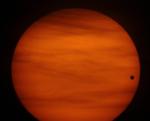 Venus Transit at Sunrise
9.06.2004
Did you see the transit? While some watched by webcast, sky gazers in Europe, the Middle East, Africa, and Asia were able to witness the complete 6 hour journey of Venus' silhouetted disk across the face of the Sun.
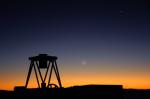 Hauoli Makahiki Hou
4.01.2006
Fading sunlight, a young crescent Moon, and brilliant Venus shared the western sky in this view of 2005's final sunset from the top of Mount Haleakala, on Maui, Hawaii. Also known as the Sacred House of the Sun, Haleakala, is Maui's dormant volcano.
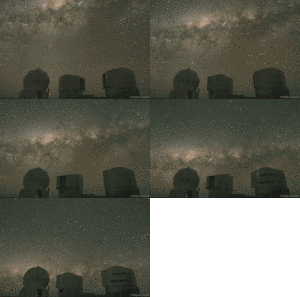 The Milky Way Over Paranal
23.01.2007
It's not the sky that's falling. More accurately, the Earth is rising. The Earth's rotation gives a continually changing view to all Earth observers, including those measuring the universe at the Paranal Observatory.
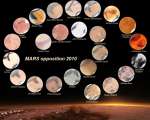 The Faces of Mars
5.05.2010
Enthusiastic astro-artists ranging from expert to beginner, the youngest age 10, all contributed their work to this entertaining panel featuring different faces of Mars. Their sketches are all based on telescopic views of the Red Planet from earlier this year, near its 2010 opposition.
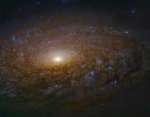 NGC 3521 Close Up
13.01.2011
Gorgeous spiral galaxy NGC 3521 is a mere 35 million light-years distant, toward the constellation Leo. Spanning some 50,000 light-years, its central region is shown in this dramatic image, constructed from data drawn from the Hubble Legacy Archive.
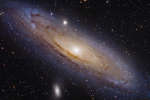 M31: The Andromeda Galaxy
26.06.2013
Andromeda is the nearest major galaxy to our own Milky Way Galaxy. Our Galaxy is thought to look much like Andromeda. Together these two galaxies dominate the Local Group of galaxies. The diffuse light from Andromeda is caused by the hundreds of billions of stars that compose it.
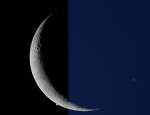 Crescent Moon Meets Evening Star
13.09.2013
On September 8, brilliant planet Venus appearing as the evening star stood near a slender, crescent Moon at sunset. The close celestial pairing or conjunction was a scene enjoyed by skygazers around the world. But from some locations in South America, the Moon actually passed in front of Venus in a lunar occultation.
|
January February March April May June July August September October |
|||||||||||||||||||||||||||||||||||||||||||||||||