
|
You entered: Sun
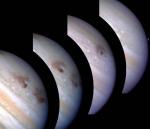 Jupiter Swallows Comet Shoemaker Levy 9
5.11.2000
What happens when a comet encounters a planet? If the planet has a rocky surface, a huge impact feature will form. A giant planet like Jupiter, however, is mostly gas. When Comet Shoemaker-Levy 9 struck Jupiter in 1994, each piece was swallowed into the vast Jovian atmosphere.
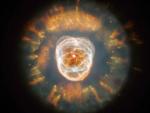 The Eskimo Nebula from Hubble
7.04.2002
In 1787, astronomer William Herschel discovered the Eskimo Nebula. From the ground, NGC 2392 resembles a person's head surrounded by a parka hood. In 2000, the Hubble Space Telescope imaged the Eskimo Nebula. From space, the nebula displays gas clouds so complex they are not fully understood.
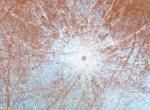 Pwyll: Icy Crater of Europa
17.04.1997
The impact crater Pwyll (a name from Celtic Mythology) is thought to represent one of the youngest features on the surface of Jupiter's moon Europa. A combination of color and high resolution black...
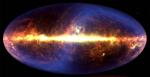 The Infrared Sky
28.01.1998
Three major sources contribute to the far-infrared sky: our Solar System, our Galaxy, and our Universe. The above image, in representative colors, is a projection of the entire infrared sky created from years of observations by the robot spacecraft COBE.
 Comet NEAT (Q4) Over Indian Cove
18.05.2004
Comet NEAT (Q4) was quite photogenic earlier this month. Although the head and part of the tails of Comet C/2001 Q4 (NEAT) were visible to the unaided eye, the best views of the colorful tail were revealed only later by cameras able to expose for long periods.
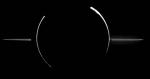 Jupiters Rings Revealed
9.01.2005
Why does Jupiter have rings? Jupiter's rings were discovered in 1979 by the passing Voyager 1 spacecraft, but their origin was a mystery. Data from the Galileo spacecraft that orbited Jupiter from 1995 to 2003 later confirmed that these rings were created by meteoroid impacts on small nearby moons.
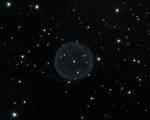 Spherical Planetary Nebula Abell 39
28.07.2005
Ghostly in appearance, Abell 39 is a remarkably simple, spherical nebula about five light-years across. Well within our own Milky Way galaxy, the cosmic sphere is roughly 7,000 light-years distant toward the constellation Hercules.
 January Aurora Over Norway
24.01.2012
What's that in the sky? An aurora. A large coronal mass ejection occurred on our Sun five days ago, throwing a cloud of fast moving electrons, protons, and ions toward the Earth. Although...
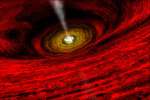 The View Near a Black Hole
23.03.2014
In the center of a swirling whirlpool of hot gas is likely a beast that has never been seen directly: a black hole. Studies of the bright light emitted by the swirling gas frequently indicate not only that a black hole is present, but also likely attributes.
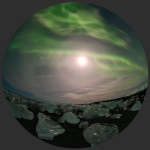 Aurora on Ice
12.02.2015
Not from a snowglobe, this expansive fisheye view of ice and sky was captured on February 1, from Jökulsárlón Beach, southeast Iceland, planet Earth. Chunks of glacial ice on the black sand beach glisten in the light of a nearly full moon surrounded by a shining halo.
|
January February March April May June July August September October |
|||||||||||||||||||||||||||||||||||||||||||||||||