
|
You entered: dark
 A Window to the Once Secret Sky
13.04.2005
If there was a window nearby to the distant universe -- would you look through it? Quite possibly, there is, in the form of a small telescope. A local skykeeper could be a relative or a stranger and is frequently proud to show off the sky free of charge.
 Mysterious White Rock Fingers on Mars
7.04.2008
What caused this unusual white rock formation on Mars? Intrigued by the possibility that they could be salt deposits left over as an ancient lakebed dried-up, detailed studies of these fingers now indicate that this is not correct.
 IC 2948: The Running Chicken Nebula
18.04.2008
Bright nebulae abound in and around the expansive southern constellation of Centaurus. This one, cataloged as IC 2948 is near the star Lambda Centauri and not far on the sky from the better known Eta Carinae Nebula.
 A Supply Ship Docks with the International Space Station
14.05.2008
Looking out a window of the International Space Station brings breathtaking views. Visible vistas include a vast and colorful Earth, a deep dark sky, and an occasional spaceship sent to visit the station. Visible early last month was a Soyuz TMA-12 spacecraft carrying not only supplies but also three newcomers.
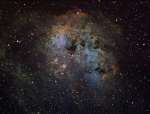 IC 410 and NGC 1893
17.01.2009
Dusty emission nebula IC 410 lies about 12,000 light-years away in the northern constellation Auriga. The cloud of glowing gas is over 100 light-years across, sculpted by stellar winds and radiation from embedded open star cluster NGC 1893.
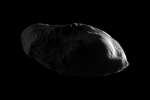 Prometheus Remastered
5.04.2010
What does Saturn's shepherd moon Prometheus really look like? The raw images from the robotic Cassini spacecraft's January flyby of the small moon showed tantalizing clues on grainy images, but now that the Cassini team has digitally remastered these images, many more details have come out.
 Mars in a Manger
30.04.2010
At opposition in late January, Mars shone very brightly in planet Earth's night sky, among the stars of the constellation Cancer the Crab. Since then the Red Planet has been fading, but still lingers in Cancer during April and May.
 Rolling Across the Rocky Plains of Mars
4.10.2010
You stare out across the rocky plains of Mars. Before you, in every direction, is dark sand and bright rock. Although little has changed here for millions of years, no one has ever seen this view before. You are being sent on a long journey to a distant crater, the largest crater in the region.
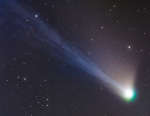 Tails of Comet Lemmon
6.05.2013
What caused the interestingly intricate tails that Comet Lemmon displayed earlier this year? First of all, just about every comet that nears the Sun displays two tails: a dust tail and an ion tail.
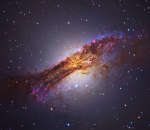 Centaurus A
19.11.2015
What's the closest active galaxy to planet Earth? That would be Centaurus A, only 11 million light-years distant. Spanning over 60,000 light-years, the peculiar elliptical galaxy is also known as NGC 5128.
|
January February March April May June July August September |
|||||||||||||||||||||||||||||||||||||||||||||||||