
|
You entered: Car
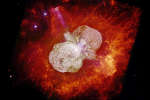 APOD: 2008 June 17- Eta Carinae and the Homunculus Nebula
17.06.2008
How did the star Eta Carinae create this unusual nebula? No one knows for sure. About 165 years ago, the southern star Eta Carinae mysteriously became the second brightest star in the night sky. In 20 years, after ejecting more mass than our Sun, Eta Car unexpected faded.
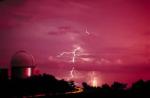 Telescope with Lightning
19.01.1999
Telescopes are not very useful during lightning storms. Nevertheless, with lightning illuminating a dark landscape, the picturesque dome of the famous Kitt Peak 2.1-meter Telescope makes for a dramatic photograph. A passing car created the red and yellow streaks visible in the foreground.
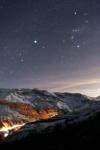 Alborz Mountains in Moonlight
3.02.2007
On January 25th, light from a first quarter Moon illuminated this dreamlike landscape looking across the rugged, snow-covered peaks of the Alborz Mountain Range in northern Iran. The stunning sky is filled with stars, including the yellow-tinged Betelgeuse at the shoulder of Orion.
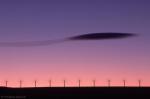 A Lenticular Cloud Over Wyoming
26.03.2003
Is that a cloud or a flying saucer? Both, although it is surely not an alien spacecraft. Lenticular clouds can be shaped like a saucer, and can fly in the sense that, like most clouds, they are composed of small water droplets that float on air.
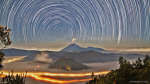 Star Trails Over Indonesia
18.08.2014
Both land and sky were restless. The unsettled land included erupting Mount Semeru in the distance, the caldera of steaming Mount Bromo on the left, flowing fog, and the lights of moving cars along roads that thread between hills and volcanoes in Bromo Tengger Semeru National Park in East Java, Indonesia.
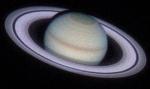 Saturn in Color
12.03.1997
Saturn is unusual but photogenic. The second largest planet in our Solar System, behind Jupiter, has been easily identifiable at night since history has been recorded. It was only with the invention of the telescope, however, that any evidence of its majestic ring system became apparent.
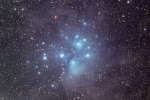 M45: The Pleiades Star Cluster
9.12.2008
Perhaps the most famous star cluster on the sky, the Pleiades can be seen without binoculars from even the depths of a light-polluted city. Also known as the Seven Sisters and M45, the Pleiades is one of the brightest and closest open clusters.
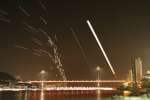 Hong Kong Sky
6.02.2010
This remarkable scene combines multiple exposures recorded on the evening of January 18th from a waterside perspective in Hong Kong, China. It follows a young crescent Moon, with brilliant planet Jupiter to its left, as they set together in the western sky. Their two luminous trails are faintly paralleled by trails of background stars.
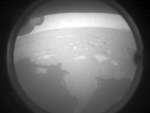 Mars Perseverance Sol 0
19.02.2021
After a 203 day interplanetary voyage, and seven minutes of terror, Perseverance has landed on Mars. Confirmation of the successful landing at Jezero crater was announced from mission control at NASAБs Jet Propulsion Laboratory in Southern California at 12:55 pm PST on February 18.
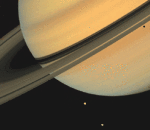 Saturn with Moons Tethys and Dione
31.05.1997
Saturn and two of its larger moons - Tethys and Dione - were photographed by the Voyager 1 spacecraft which flew by the planet in November of 1980. This picture gives an indication of Saturn's extensive ring system, which can be seen casting a shadow on the planet, as does Tethys.
|
January February March April May June July August September October |
|||||||||||||||||||||||||||||||||||||||||||||||||