
|
You entered: Corona Australis
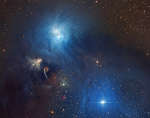 Stars and Dust in Corona Australis
7.01.2015
Cosmic dust clouds and young, energetic stars inhabit this telescopic vista, less than 500 light-years away toward the northern boundary of Corona Australis, the Southern Crown. The dust clouds effectively block light from more distant background stars in the Milky Way.
 Stars and Dust Across Corona Australis
12.09.2013
Cosmic dust clouds sprawl across a rich field of stars in this sweeping telescopic vista near the northern boundary of Corona Australis, the Southern Crown. Less than 500 light-years away the dust clouds effectively block light from more distant background stars in the Milky Way.
 Across Corona Australis
29.11.2018
Cosmic dust clouds are draped across a rich field of stars in this broad telescopic panorama near the northern boundary of Corona Australis, the Southern Crown. Less than 500 light-years away the denser clouds effectively block light from more distant background stars in the Milky Way.
 Stars and Dust across Corona Australis
22.06.2023
Cosmic dust clouds cross a rich field of stars in this telescopic vista near the northern boundary of Corona Australis, the Southern Crown. Part of a sprawling molecular cloud complex this star forming region is a mere 500 light-years away.
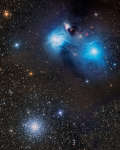 Stars and Dust Across Corona Australis
6.08.2021
Cosmic dust clouds cross a rich field of stars in this telescopic vista near the northern boundary of Corona Australis, the Southern Crown. Less than 500 light-years away the dust clouds effectively block light from more distant background stars in the Milky Way.
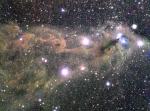 Star Clouds Toward the Southern Crown
2.10.2002
The flowing trails of dust toward Corona Australis, the constellation of the Southern Crown, are visible here because not because they glow, but because they absorb and reflect. The dust appears bluer when seen near bright stars because it preferentially reflects blue light.
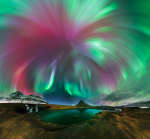 Auroral Corona
1.01.2026
Cycle 25 solar maximum made 2025 a great year for aurora borealis (or aurora australis) on planet Earth. And the high level of solar activity should extend into 2026. So, while you're celebrating the arrival of the new year, check out this spectacular auroral display that erupted in starry night skies over Kirkjufell, Iceland.
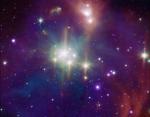 Coronet in the Southern Crown
21.09.2007
X-rays from young stars and infrared light from stars and cosmic dust are combined in this false color image of a star-forming region in Corona Australis, the Southern Crown. The small star grouping is fittingly known as the Coronet Cluster.
 APOD: 2024 September 24 Б NGC 6727: The Rampaging Baboon Nebula
24.09.2024
This dusty region is forming stars. Part of a sprawling molecular cloud complex that resembles, to some, a rampaging baboon, the region is a relatively close by 500 light-years away toward the constellation Corona Australis. That's about one third the distance of the more famous stellar nursery known as the Orion Nebula.
|
January February March April May June July August September October |
|||||||||||||||||||||||||||||||||||||||||||||||||