
|
You entered: Deep Sky
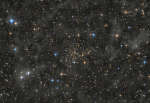 APOD: 2026 May 13 Б NGC 188: Old Cluster in the New General Catalog
13.05.2026
The New General Catalog of star clusters and nebulae really isn't so new. In fact, it was published in 1888 - an effort by J. L. E. Dreyer to consolidate the work of astronomers William, Caroline, and John Herschel along with others into a useful single, complete catalog of astronomical discoveries and measurements.
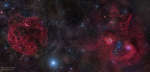 Downtown Auriga
13.02.2014
Rich in star clusters and nebulae, the ancient constellation of Auriga, the Charioteer, rides high in northern winter night skies. Spanning nearly 24 full moons (12 degrees) on the sky, this deep telescopic mosaic view recorded in January shows off some of Auriga's most popular sights for cosmic tourists.
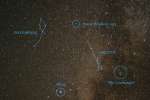 Nova Delphini 2013
16.08.2013
Using a small telescope to scan the skies on August 14, Japanese amateur astronomer Koichi Itagaki discovered a "new" star within the boundaries of the constellation Delphinus. Indicated in this skyview captured on August 15 from Stagecoach, Colorado, it is now appropriately designated Nova Delphini 2013.
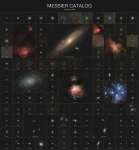 APOD: 2026 May 14 Б The Messier Catalog at Uniform Scale
14.05.2026
What are some of the most interesting astronomical objects you can see in the night sky? Armed with a good pair of binoculars or a small telescope, if you live in the Northern Hemisphere, you can look for the very popular objects in the Messier Catalog.
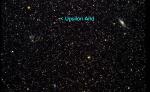 Where is Upsilon Andromedae
22.04.1999
Astronomers recently announced the detection of three large planets orbiting the star Upsilon Andromedae - the first planetary system known to orbit a normal star other than our Sun. These planets were not directly photographed but found through a Doppler technique developed to use large telescopes to search nearby stars for wobbling planetary signatures.
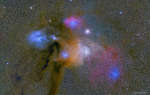 Colorful Clouds Near Rho Ophiuchi
6.07.2015
Why is the sky near Antares and Rho Ophiuchi so colorful? The colors result from a mixture of objects and processes. Fine dust illuminated from the front by starlight produces blue reflection nebulae. Gaseous clouds whose atoms are excited by ultraviolet starlight produce reddish emission nebulae. Backlit dust clouds block starlight and so appear dark.
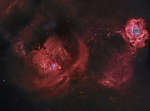 Field of Rosette
14.02.2010
What surrounds the florid Rosette nebula? To better picture this area of the sky, the famous flowery emission nebula on the far right has been captured recently in a deep and dramatic wide field image that features several other sky highlights.
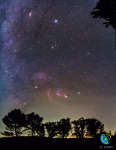 Comet Lovejoy in a Winter Sky
27.01.2015
Which of these night sky icons can you find in this beautiful and deep exposure of the northern winter sky? Skylights include the stars in Orion's belt, the Orion Nebula, the Pleiades star cluster, the bright stars Betelgeuse and Rigel, the California Nebula, Barnard's Loop, and Comet Lovejoy.
 Comets Lemmon and PanSTARRS Peaking
5.03.2013
Two impressive comets will both reach their peak brightness during the next two weeks. Taking advantage of a rare imaging opportunity, both of these comets were captured in the sky together last week over the Atacama desert in South America.
 Comet Lovejoy s Tail
16.01.2015
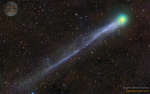
Sweeping north in planet Earth's sky, Comet Lovejoy's greenish coma and blue tinted ion tail stretched across this field of stars in the constellation Taurus on January 13. The inset at the upper left shows the 1/2 degree angular size of the full moon for scale.
|
January February March April May June July August September |
|||||||||||||||||||||||||||||||||||||||||||||||||