
|
You entered: Great Dark Spot
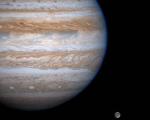 Jupiter Eyes Ganymede
12.12.2000
Who keeps an eye on the largest moon in the Solar System? This moon, visible on the lower right, is Ganymede, and the planet it orbits, Jupiter, seems to be keeping a watchful eye, as its Great Red Spot appears serendipitously nearby.
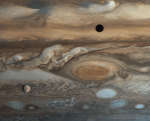 Europa and Jupiter from Voyager 1
28.06.2020
What are those spots on Jupiter? Largest and furthest, just right of center, is the Great Red Spot -- a huge storm system that has been raging on Jupiter possibly since Giovanni Cassini's likely notation of it 355 years ago. It is not yet known why this Great Spot is red.
 Europa and Jupiter from Voyager 1
17.07.2022
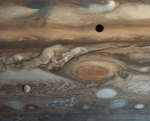
What are those spots on Jupiter? Largest and furthest, just right of center, is the Great Red Spot -- a huge storm system that has been raging on Jupiter possibly since Giovanni Cassini's likely notation of it 357 years ago. It is not yet known why this Great Spot is red.
 Europa and Jupiter from Voyager 1
5.09.2017
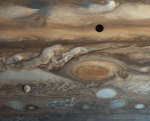
What are those spots on Jupiter? Largest and furthest, just right of center, is the Great Red Spot -- a huge storm system that has been raging on Jupiter possibly since Giovanni Cassini's likely notation of it 352 years ago. It is not yet known why this Great Spot is red.
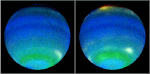 The Weather on Neptune
28.10.1996
Today's weather on Neptune will be typical. Highs in the upper atmosphere will be about -150 Centigrade, with winds ranging about 900 miles per hour near the equator. Much was learned recently about Neptune's weather by the release last week of time-lapse pictures of the most distant gas giant in our Solar System.
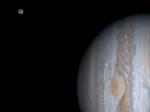 Jupiter, Europa, and Callisto
2.01.2001
As the robot Cassini spacecraft rounds Jupiter on its way toward Saturn, it has taken a sequence of images of the gas giant with its four largest moons. Previously released images have highlighted Ganymede and Io. Pictured above are the two remaining Galilean satellites: Europa and Callisto.
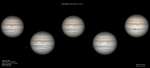 Jupiter and Io
28.11.2012
On December 3 (UT), Jupiter, the solar system's largest planet, will be at opposition, opposite the Sun in planet Earth's sky, shining brightly and rising as the Sun sets. That configuration results in Jupiter's almost annual closest approach to planet Earth.
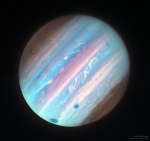 Jupiter in Ultraviolet from Hubble
16.10.2018
Jupiter looks a bit different in ultraviolet light. To better interpret Jupiter's cloud motions and to help NASA's robotic Juno spacecraft understand the planetary context of the small fields that it sees, the Hubble Space Telescope is being directed to regularly image the entire Jovian giant.
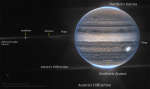 Jupiter from the Webb Space Telescope
30.08.2022
This new view of Jupiter is illuminating. High-resolution infrared images of Jupiter from the new James Webb Space Telescope (Webb) reveal, for example, previously unknown differences between high-floating bright clouds -- including the Great Red Spot -- and low-lying dark clouds.
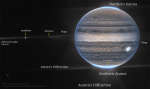 APOD: 2026 January 18 Б Jupiter from the Webb Space Telescope
18.01.2026
This infrared view of Jupiter by Webb is illuminating. High-resolution infrared images of Jupiter from the James Webb Space Telescope (Webb) reveal, for example, differences between high-floating bright clouds -- including the Great Red Spot -- and low-lying dark clouds.
|
January February March April May June July August September |
|||||||||||||||||||||||||||||||||||||||||||||||||