
|
You entered: KPNO
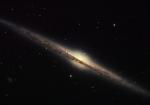 NGC 4565: Galaxy on the Edge
9.04.2004
Magnificent spiral galaxy NGC 4565 is viewed edge-on from planet Earth. Also known as the Needle Galaxy for its narrow profile, bright NGC 4565 is a stop on many springtime telescopic tours of the northern sky as it lies in the faint but well-groomed constellation Coma Berenices.
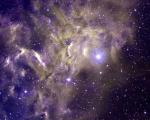 AE Aurigae: The Flaming Star
4.12.2001
Is star AE Aurigae on fire? Although surrounded by what may look like smoke, the object known as the "flaming star" creates energy primarily by nuclear fusion, like other stars. Fire, typically defined...
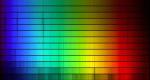 Stellar Spectral Types: OBAFGKM
30.05.2001
Astronomers divide stars into different spectral types. First started in the 1800s, the spectral type was originally meant to classify the strength of hydrogen absorption lines. A few types that best describe the temperature of the star remain in use today.
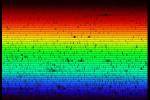 The Solar Spectrum
15.08.2000
It is still not known why the Sun's light is missing some colors. Shown above are all the visible colors of the Sun, produced by passing the Sun's light through a prism-like device.
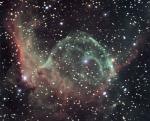 NGC 2359: Thor s Helmet
5.12.2002
NGC 2359 is a striking emission nebula with an impressive popular name - Thor's Helmet. Sure, its suggestive winged appearance might lead some to refer to it as the "duck nebula", but if you were a nebula which name would you choose?
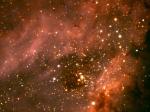 Composing the Omega Nebula
11.12.2000
The Omega Nebula is a massive, complex cloud of dust and gas from which new stars are continually forming. The similarity to the Greek letter capital Omega gives the molecular cloud its popular name, but the nebula is also known as the Swan Nebula, the Horseshoe Nebula, and M17.
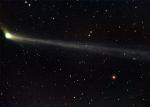 Comet C 2002 T7 (LINEAR)
22.04.2004
Discovered by the the Lincoln Near Earth Asteroid Research (LINEAR) project in October of 2002, comet C/2002 T7 is now visiting the inner solar system, making its closest approach (see animation by L. Koehn) to the Sun tomorrow, April 23rd.
 NGC 4631: The Whale Galaxy
29.03.2002
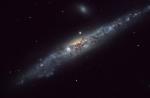
NGC 4631 is a big beautiful spiral galaxy seen edge-on only 25 million light-years away towards the small northern constellation Canes Venatici. This galaxy's slightly distorted wedge shape suggests to some a cosmic herring and to others the popular moniker of The Whale Galaxy.
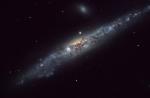 NGC 4631: The Whale Galaxy
23.01.2004
NGC 4631 is a big beautiful spiral galaxy seen edge-on only 25 million light-years away towards the small northern constellation Canes Venatici. This galaxy's slightly distorted wedge shape suggests to some a cosmic herring and to others the popular moniker of The Whale Galaxy.
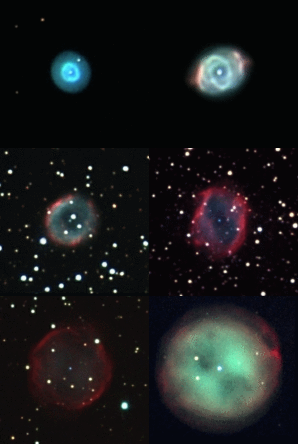 The Planetary Nebula Show
3.10.2001
What do the Owl, the Cat's Eye, the Ghost of Jupiter, and Saturn have in common? They're all planetary nebulae of course(!), glowing gaseous shrouds shed by dying sun-like stars as they run out of nuclear fuel.
|
January February March April May June July August September October |
|||||||||||||||||||||||||||||||||||||||||||||||||