
|
You entered: SDSS
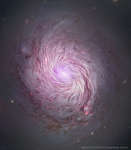 The Magnetic Fields of Spiral Galaxy M77
16.12.2019
Can magnetic fields help tell us how spiral galaxies form and evolve? To find out, the HAWC+ instrument on NASA's airborne (747) SOFIA observatory observed nearby spiral galaxy M77. HAWC+ maps magnetism by observing polarized infrared light emitted by elongated dust grains rotating in alignment with the local magnetic field.
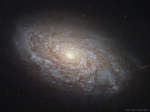 NGC 4414: A Flocculent Spiral Galaxy
20.11.2016
How much mass do flocculent spirals hide? The featured true color image of flocculent spiral galaxy NGC 4414 was taken with the Hubble Space Telescope to help answer this question. The featured image was augmented with data from the Sloan Digital Sky Survey (SDSS).
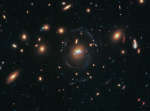 A Blue Bridge of Stars between Cluster Galaxies
15.07.2014
Why is there a blue bridge of stars across the center of this galaxy cluster? First and foremost the cluster, designated SDSS J1531+3414, contains many large yellow elliptical galaxies. The cluster's center...
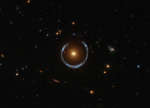 A Horseshoe Einstein Ring from Hubble
21.12.2011
What's large and blue and can wrap itself around an entire galaxy? A gravitational lens mirage. Pictured above, the gravity of a luminous red galaxy (LRG) has gravitationally distorted the light from a much more distant blue galaxy.
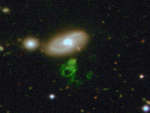 What is Hanny's Voorwerp?
25.06.2008
What is that green thing? A volunteer sky enthusiast surfing through online Galaxy Zoo images has discovered something really strange. The mystery object is unusually green, not of any clear galaxy type, and situated below relatively normal looking spiral galaxy IC 2497.
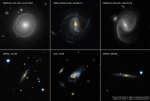 Spiral Galaxies Spinning Super Fast
5.11.2019
Why are these galaxies spinning so fast? If you estimated each spiral's mass by how much light it emits, their fast rotations should break them apart. The leading hypothesis as to why these galaxies don't break apart is dark matter -- mass so dark we can't see it.
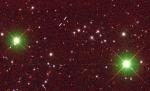 Methane Dwarf
3.06.1999
While hunting through Sloan Sky Survey data in search of distant quasars, Princeton astronomers Xiaohui Fan and Michael Strauss came upon an undiscovered type of object very nearby - now dubbed a methane dwarf. Marked...
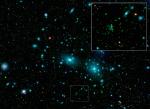 Dwarf Galaxies in the Coma Cluster
31.05.2007
In visible light images, over a thousand galaxies are seen to lie within a volume about 20 million light-years across in the rich Coma Galaxy Cluster. But infrared images of the Coma Cluster have now been used to add thousands more to the Coma's galaxy count in the form of previously undiscovered dwarf galaxies.
 Galaxy Zoo Catalogs the Universe
26.10.2009
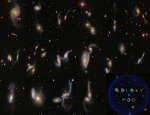
You, too, can Zoo. The Galaxy Zoo project has been enabling citizen scientists -- inquisitive people like yourself armed with only a web browser-- to sort through the universe. Specifically, after a brief training session...
 SN 2005ap: The Brightest Supernova Yet Found
16.10.2007
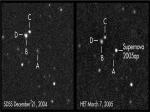
What could cause a bang this big? This supernova explosion was so inherently bright that it could be seen nearby 5 billion light years away (a redshift of 0.28) even with a small telescope.
|
January February March April May June July August September |
|||||||||||||||||||||||||||||||||||||||||||||||||