
|
You entered: TRACE
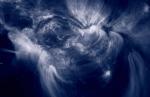 Solar Moss
27.12.1999
Discovered in recent close-up pictures of the Sun from NASA's Transition Region And Coronal Explorer (TRACE) spacecraft, this spongy-looking stuff has a temperature of 2 million degrees Fahrenheit ... and has been dubbed "Solar Moss". The false-color TRACE image above was recorded in extreme ultraviolet light on October 18.
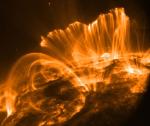 Coronal Rain, Solar Storm
15.11.2000
In this picture, the Sun's surface is quite dark. A frame from a movie recorded on November 9th by the orbiting TRACE telescope, it shows coronal loops lofted over a solar active region.
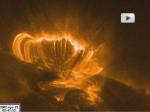 An X Class Flare Region on the Sun
6.11.2007
Why does the Sun flare? Unpredictably, our Sun unleashes tremendous flares expelling hot gas into the Solar System that can affect satellites, astronauts, and power grids on Earth. This close up of an active region on the Sun that produced a powerful X-class flare was captured by the orbiting TRACE satellite.
 AR9077: Solar Magnetic Arcade
20.07.2000
On July 14th, solar active region 9077 (AR9077) produced a massive flare. The event also blasted an enormous cloud of energetic charged particles toward planet Earth, triggering magnetic storms and dramatic auroral displays. This striking close-up of AR9077 was made by the orbiting TRACE satellite shortly after the flare erupted.
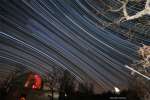 Haute Provence Star Trails
14.03.2009
Fix your camera to a tripod and you can record the graceful trails traced by the stars as planet Earth rotates on its axis. For example, this dramatic 5 hour long exposure was made on February 24 from Haute-Provence Observatory (OHP) in southeastern France.
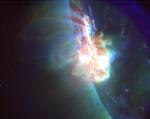 An Active Region of the Sun
16.06.1998
The Sun is a busy place. This false-color image depicts an active region near an edge of the Sun. Hot plasma is seen exploding off the Sun's photosphere and traveling along loops defined by the Sun's magnetic field.
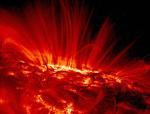 Sunspot Loops in Ultraviolet
8.05.2002
It was a quiet day on the Sun. The above image shows, however, that even during off days the Sun's surface is a busy place. Shown in ultraviolet light, the relatively cool dark regions have temperatures of thousands of degrees Celsius.
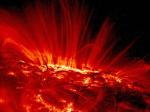 Sunspot Loops in Ultraviolet
10.10.2004
It was a quiet day on the Sun. The above image shows, however, that even during off days the Sun's surface is a busy place. Shown in ultraviolet light, the relatively cool dark regions have temperatures of thousands of degrees Celsius.
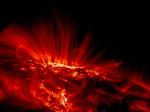 Sunspot Loops in Ultraviolet
11.06.2006
It was a quiet day on the Sun. The above image shows, however, that even during off days the Sun's surface is a busy place. Shown in ultraviolet light, the relatively cool dark regions have temperatures of thousands of degrees Celsius.
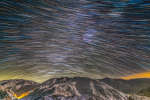 Alborz Mountain Star Trails
2.03.2018
Colourful star trails arc through the night in this wide-angle mountain and skyscape. From a rotating planet, the digitally added consecutive exposures were made with a camera fixed to a tripod and looking south, over northern Iran's Alborz Mountain range.
|
January February March April May June July August September October |
|||||||||||||||||||||||||||||||||||||||||||||||||