
|
You entered: Voyager project
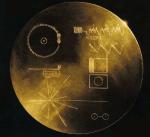 The Voyagers Message in a Bottle
8.09.2007
Launched thirty years ago, NASA's Voyager 1 and 2 spacecraft are now respectively 15 billion and 12.5 billion kilometers from the Sun, equivalent to about 14 and 11.5 light-hours distant. Still functioning, the Voyagers are being tracked and commanded through the Deep Space Network.
 The Voyagers' Message in a Bottle
29.06.1996
Launched in the summer of 1977, NASA's Voyager 1 and 2 spacecraft are now over 4.5 billion miles from the Sun. Still operational, the Voyagers are being tracked and commanded through the Deep Space Network.
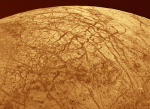 Europa's Surface
13.08.1996
Voyager spacecraft images of Europa's surface, like the one above, are suggestive of sea ice on Earth. The criss-crossing dark streaks may indeed be cracks in its ice-covered surface caused by Jupiter's tidal stresses accompanied by the freezing and expansion of an underlying layer of water.
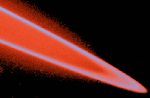 Jupiter's Rings
2.08.1995
Astronomers using NASA's Voyager spacecraft to search for a ring system around Jupiter discovered these faint rings in 1979. Unlike Saturn's bright rings which are composed of chunks of rock and ice, Jupiter's rings appear to consist of fine particles of dust.
 Io: The Fissure King?
29.11.1996
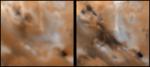
Is Io the solar system's Fissure King? Well, probably not ... but it is the most active volcanic moon. Active volcanoes on Jupiter's moon Io were a surprise discovery of the Voyager missions of the late 1970s.
 Callisto Full Face
9.12.1996
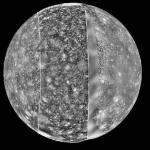
Callisto's surface shows its age. While probably formed at the same time as Io, the difference between the surfaces of these two moons of Jupiter could hardly be greater. Io's surface is young, shows practically no impact craters, and is continually being repaved by the lava exploding from its many large volcanoes.
 Jupiter And Family
29.09.1997
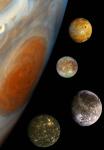
This composite image features classic portraits of members of one of the Solar System's most prominent families - Jupiter and its four large "Galilean" moons. Starting from the top the moons are Io, Europa, Ganymede, and Callisto. The top-to-bottom order is also the order of increasing distance from Jupiter.
 Jupiter And Family
18.11.2000
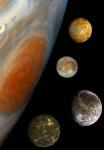
This composite image features classic portraits of members of one of the Solar System's most prominent families - Jupiter and its four large "Galilean" moons. Starting from the top the moons are Io, Europa, Ganymede, and Callisto. The top-to-bottom order is also the order of increasing distance from Jupiter.
 Voyager's Preview of Galileo at Ganymede
27.06.1996
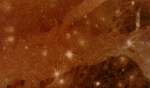
NASA's robot spacecraft Galileo began its long voyage to Jupiter in October of 1989. In December of last year it arrived in the Jovian system, beginning its unprecedented, detailed exploration by dropping a probe into the gas giant's atmosphere. By early this morning it will have accomplished another milestone in its ambitious mission.
 Closeup of an Io Volcano
4.08.1995
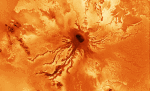
In 1979, one of NASA's Voyager spacecraft made a spectacular and unexpected discovery. Io, the innermost Galilean moon of Jupiter, was covered with volcanoes and some of them were erupting! In all, Voyager 1 observed nine volcanic eruptions during its encounter with the moon.
|
January February March April May June July August September October |
|||||||||||||||||||||||||||||||||||||||||||||||||