
|
You entered: aircraft
 APOD: 2026 September 5 Б Chasing the Moon s Shadow
5.09.2026
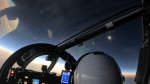
Chasing the shadow of a New Moon, NASAБs WB-57F high altitude research aircraft took to the skies off the coast of Iceland on August 12 to observe a total solar eclipse. At 50,000 feet the aircraft was piloted along the precisely determined path of totality to maximize its time in the MoonБs shadow.
 ISS and Mercury Too
13.05.2016
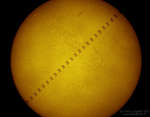
Transits of Mercury are relatively rare. Monday's leisurely 7.5 hour long event was only the 2nd of 14 Mercury transits in the 21st century. If you're willing to travel, transits of the International Space Station can be more frequent though, and much quicker.
 Blue Jet Lightning
12.11.1995
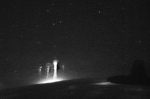
Recently two new types of lightning have been verified: red sprites and blue jets. These atmospheric discharges occur very high in the Earth's atmosphere - much higher than the familiar form of lightning. Blue jets appear blue in color and go from the tops of clouds to a height of about 50 kilometers.
 Northern Lights from the Stratosphere
18.01.2024
Northern lights shine in this night skyview from planet Earth's stratosphere, captured on January 15. The single, 5 second exposure was made with a hand-held camera on board an aircraft above Winnipeg, Canada. During the exposure, terrestrial lights below leave colorful trails along the direction of motion of the speeding aircraft.
 Astronomy From An F-18
28.01.2000
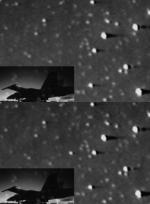
In an era of blossoming ground and space-based observatories, astronomers are also pushing the envelope with airborne instrumentation - successfully capturing an asteroid occultation from a high performance jet aircraft. This blinking animation represents...
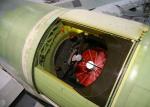 SOFIA s Window Seat
25.02.2006
Earlier this month, a 2.5-meter diameter infrared telescope was permanently assigned a window seat, looking through this opening in the fuselage of a historic Boeing 747 aircraft. The telescope mirror, about the size of the Hubble Space Telescope mirror, is protected by a red covering.
 The Shadow of Ingenuity s Damaged Rotor Blade
10.02.2024
On January 18, 2024, during its 72nd flight in the thin Martian atmosphere, autonomous Mars Helicopter Ingenuity rose to an altitude of 12 meters (40 feet) and hovered for 4.5 seconds above the Red Planet. Ingenuity's 72nd landing was a rough one though.
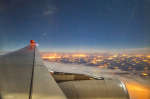 Planets on the Wing
6.01.2018
Lately, bright Jupiter and fainter Mars have been easy to spot for early morning skygazers. Before dawn on January 7 the two naked-eye planets will reach a close conjunction near the horizon, only 1/4 degree apart in predawn eastern skies. That apparent separation corresponds to about half the angular diameter of a Full Moon.
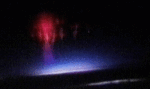 Red Sprite Lightning
11.11.1995
Recently two new types of lightning have been verified: red sprites and blue jets. These atmospheric discharges occur very high in the Earth's atmosphere - much higher than the familiar form of lightning.
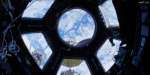 ISS Fisheye Flythrough
5.11.2016
Shot in Ultra HD, this stunning video can take you on a tour of the International Space Station. A fisheye lens with sharp focus and extreme depth of field provides an immersive visual experience of life in the orbital outpost.
|
January February March April May June July August September October |
|||||||||||||||||||||||||||||||||||||||||||||||||