
|
You entered: binary star
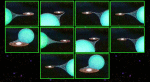 Black Hole Signature From Advective Disks
15.01.1997
What does a black hole look like? If alone, a black hole would indeed appear quite black, but many black hole candidates are part of binary star systems. So how does a black hole binary system look different from a neutron star binary system? The above drawings indicate it is difficult to tell!
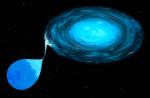 Accretion Disk Binary System
19.12.1999
Our Sun is unusual in that it is alone - most stars occur in multiple or binary systems. In a binary system, the higher mass star will evolve faster and will eventually become a compact object - either a white dwarf star, a neutron star, or black hole.
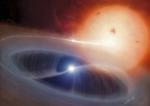 An Intermediate Polar Binary System
10.11.2003
How can two stars create such a strange and intricate structure? Most stars are members of multiple-star systems. Some stars are members of close binary systems where material from one star swirls around the other in an accretion disk.
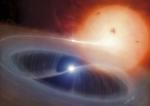 An Intermediate Polar Binary System
21.05.2006
How can two stars create such a strange and intricate structure? Most stars are members of multiple-star systems. Some stars are members of close binary systems where material from one star swirls around the other in an accretion disk.
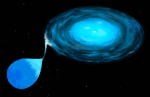 Accretion Disk Binary System
26.12.1995
Our Sun is unusual in that it is alone - most stars occur in multiple or binary systems. In a binary system, the higher mass star will evolve faster and will eventually become a compact object - either a white dwarf star, a neutron star, or black hole.
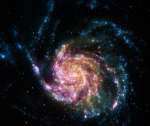 21st Century M101
13.07.2012
One of the last entries in Charles Messier's famous catalog, big, beautiful spiral galaxy M101 is definitely not one of the least. About 170,000 light-years across, this galaxy is enormous, almost twice the size of our own Milky Way Galaxy.
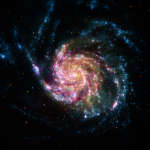 21st Century M101
6.11.2019
One of the last entries in Charles Messier's famous catalog, big, beautiful spiral galaxy M101 is definitely not one of the least. About 170,000 light-years across, this galaxy is enormous, almost twice the size of our own Milky Way Galaxy.
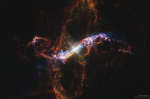 Symbiotic R Aquarii
11.07.2018
You can see it change in brightness with just binoculars over the course of a year. Variable star R Aquarii is actually an interacting binary star system, two stars that seem to have a close, symbiotic relationship.
 T Pyxidis: Recurrent Nova
25.09.1997
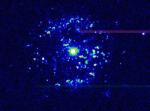
What happens when a thermonuclear blast occurs on the surface of a white dwarf star? Over the years astronomers have watched (at a safe distance ...) as, 6,000 light years from Earth in the southern constellation Pyxis, a binary star known as T Pyxidis repeatedly produces these fearsome explosions.
 Symbiotic R Aquarii
29.06.2017
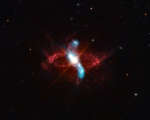
A long recognized naked-eye variable star, R Aquarii is actually an interacting binary star system, two stars that seem to have a close, symbiotic relationship. About 710 light years away, it consists of a cool red giant star and hot, dense white dwarf star in mutual orbit around their common center of mass.
|
January February March April May June July August September October November |
||||||||||||||||||||||||||||||||||||||||||||||||||||||||