
|
You entered: comet tail
 APOD: 2024 October 7 Б The Long Tails of Comet Tsuchinshan ATLAS
7.10.2024
A bright comet is moving into the evening skies. C/2023 A3 (TsuchinshanБATLAS) has brightened and even though it is now easily visible to the unaided eye, it is so near to the Sun that it is still difficult to see. Pictured, Comet TsuchinshanБATLAS was captured just before sunrise from an Andes Mountain in Peru.
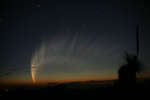 The Magnificent Tail of Comet McNaught
6.12.2009
Comet McNaught, the Great Comet of 2007, was the brightest comet of the last 40 years. Its spectacular tail spread across the sky and was breathtaking to behold from dark locations for many Southern Hemisphere observers.
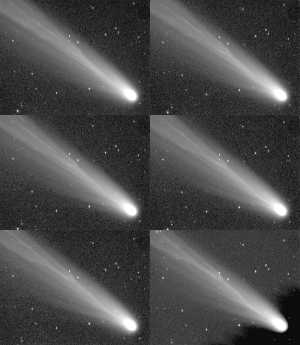 Tail Wags of Comet Ikeya Zhang
15.05.2002
As Comet Ikeya-Zhang approached the Sun two months ago, it developed a complex blue ion tail. The tail was composed of ions that boiled off the nucleus and were pushed away from the Sun by the out-flowing fast-moving particles of the solar wind.
 Structure in the Tail of Comet 12P/Pons Brooks
16.02.2024
Heading for its next perihelion passage on April 21, Comet 12P/Pons-Brooks is growing brighter. The greenish coma of this periodic Halley-type comet has become relatively easy to observe in small telescopes. But the bluish...
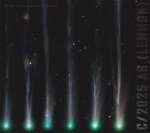 APOD: 2025 October 6 Б The Changing Ion Tail of Comet Lemmon
6.10.2025
How does a comet tail change? It depends on the comet. The ion tail of Comet C/2025 A6 (Lemmon) has been changing markedly, as detailed in the featured image sequenced over six days between September 25 and October 4 (left to right) from Texas, USA.
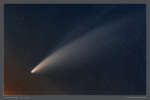 The Tails of Comet NEOWISE
11.07.2020
Comet NEOWISE (C/2020 F3) is now sweeping through northern skies. Its developing tails stretch some six degrees across this telescopic field of view, recorded from Brno, Czech Republic before daybreak on July 10. Pushed out by the pressure of sunlight itself, the comet's broad, yellowish dust tail is easiest to see.
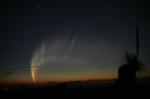 The Magnificent Tail of Comet McNaught
22.01.2007
Comet McNaught, the Great Comet of 2007, has grown a long and filamentary tail. The spectacular tail spreads across the sky and is visible to Southern Hemisphere observers just after sunset. The head of the comet remains quite bright and easily visible to even city observers without any optical aide.
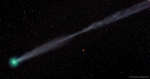 A Split Ion Tail for Comet Lovejoy E4
25.04.2017
What's happened to Comet Lovejoy? In the pictured image, a processed composite, the comet was captured early this month after brightening unexpectedly and sporting a long and intricate ion tail. Remarkably, the typically...
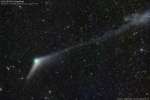 Comet Catalina Tails
1.01.2016
A new year's treat for binoculars, as 2016 begins Comet Catalina (C/2013 US10) now sweeps through planet Earth's predawn skies near bright Arcturus, alpha star of Bootes. But this telescopic mosaic from December 21 follows the pretty tails of the comet across a field of view as wide as 10 full moons.
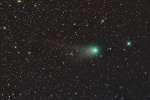 Tails of Comet Garradd
20.10.2011
A good target for binoculars and small telescopes, Comet Garradd (C/2009 P1) now shines in planet Earth's evening skies, a steady performer but just below naked-eye visibility. Telescopic images like this composite from...
|
January February March April May June July August September |
|||||||||||||||||||||||||||||||||||||||||||||||||