
|
You entered: compton
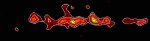 Radioactive Clouds in the Milky Way
28.10.1995
When massive stars explode they create large radioactive blast clouds which expand into interstellar space. As the radioactive elements decay, they produce gamma-rays. Possible locations of these stellar explosions known as supernovae, are indicated by the bright clumps in this map of the central regions of our Milky Way Galaxy.
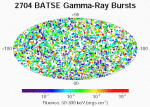 BATSE GRB Final Sky Map
28.06.2000
What causes the most powerful explosions in the universe? The BATSE modules that flew on the Compton Gamma Ray Observatory allowed more insight into enigmatic gamma-ray burst (GRB) explosions than ever before. From 1991-2000, BATSE detected 2704 GRBs, much more than ever previously recorded.
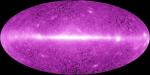 The Gamma Ray Sky
11.01.2002
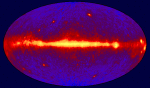
What if you could see gamma rays? If you could, the sky would seem to be filled with a shimmering high-energy glow from the most exotic and mysterious objects in the Universe.
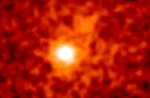 Gamma Ray Quasar
25.12.1998
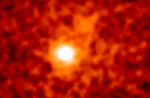
The bright object in the center of the false color image above is quasar 3C279 viewed in gamma-rays, photons with more than 40 million times the energy of visible light. Like all quasars, 3C279 is a nondescript, faint, star-like object in the visible sky.
 A Quasar in the Gamma Ray Sky
16.11.1996
The bright object in the center of the false color image above is quasar 3C279 viewed in gamma-rays, photons with more than 40 million times the energy of visible light. Like all quasars, 3C279 is a nondescript, faint, starlike object in the visible sky.
 The Gamma Ray Sky
20.03.1998
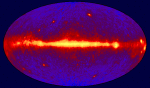
What if you could "see" gamma rays? If you could, the sky would seem to be filled with a shimmering high-energy glow from the most exotic and mysterious objects in the Universe.
 The Gamma Ray Sky
21.02.1997
What if you could "see" gamma rays? If you could, the sky would seem to be filled with a shimmering high-energy glow from the most exotic and mysterious objects in the Universe.
 COMPTEL Explores The Radioactive Sky
24.07.1996
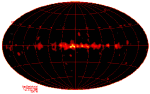
Diffuse gas clouds laced with radioactive aluminum atoms (Al26) line the plane of our Milky Way Galaxy! How do we see them? Relying on the Compton Effect, the COMPTEL instrument onboard NASA's immense orbiting Compton Gamma Ray Observatory can "see" the 1.8 million electron Volt gamma rays emitted by the radioactive decay.
 Gamma Ray Bursts from the Unknown
22.11.1996
Gamma Ray Bursts (GRBs) pose one of the greatest mysteries of modern astronomy. About once a day, the gamma-ray sky lights up with a spectacular explosion. No one knows what causes these explosions or even how far away they are.
 The COMPTEL Gamma-Ray Sky
29.05.1996
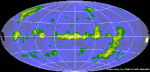
This premier gamma-ray view of the sky was produced by the COMPTEL instrument onboard NASA's orbiting Compton Gamma Ray Observatory. The entire sky is seen projected on a coordinate system centered on our Milky Way Galaxy with the plane of the Galaxy running across the middle of the picture.
|
January February March April May June July August September October |
|||||||||||||||||||||||||||||||||||||||||||||||||