
|
You entered: cosmology
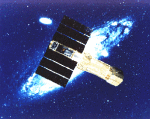 ASCA X-Ray Observatory
20.02.1996
Today marks the third anniversary of the launch of the Advanced Satellite for Cosmology and Astrophysics (ASCA; renamed from Astro D when launched). ASCA, seen here superposed on galaxy M31, is a Japanese satellite for which NASA has provided some scientific equipment. ASCA carries four large-area X-ray telescopes.
 Stellar Streams in the Local Universe
27.09.2024
The twenty galaxies arrayed in these panels are part of an ambitious astronomical survey of tidal stellar streams. Each panel presents a composite view; a deep, inverted image taken from publicly available imaging surveys of a field that surrounds a nearby massive galaxy image.
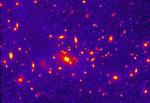 A Massive Cluster In A Young Universe
21.08.1998
Conventional theories suggest that this cluster of galaxies should not exist. Each fuzzy spot in this false-color Hubble Space Telescope image of the central regions of a newly discovered galaxy cluster is a galaxy similar in mass to our own Milky Way.
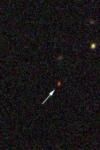 High Redshift Quasars
11.12.1998
Each red speck indicated above is a powerful quasar estimated to be over 100 times brighter than a galaxy. Yet in these Sloan Digital Sky Survey discovery images the quasars appear faint because they are extremely distant.
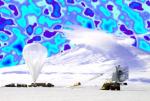 The Race to Reveal Our Universe
9.05.2000
A race is underway to understand our universe through background radiation produced during its infancy. Observationally, increasingly accurate balloon experiments are pressing to beat future space-faring satellites to definitive measurements of universe-determining spot characteristics of the cosmic microwave background (CMB) radiation.
 WMAP Resolves the Universe
11.07.2004
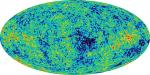
Analyses of a new high-resolution map of microwave light emitted only 380,000 years after the Big Bang appear to define our universe more precisely than ever before. The eagerly awaited results announced last year from the orbiting Wilkinson Microwave Anisotropy Probe resolve several long-standing disagreements in cosmology rooted in less precise data.
 WMAP Resolves the Universe
25.09.2005
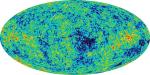
Analyses of a new high-resolution map of microwave light emitted only 380,000 years after the Big Bang appear to define our universe more precisely than ever before. The eagerly awaited results announced last year from the orbiting Wilkinson Microwave Anisotropy Probe resolve several long-standing disagreements in cosmology rooted in less precise data.
 WMAP Resolves the Universe
12.02.2003
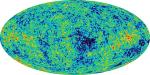
Analyses of a new high-resolution map of microwave light emitted only 380,000 years after the Big Bang appear to define our universe more precisely than ever before. The eagerly awaited results from the orbiting Wilkinson Microwave Anisotropy Probe resolve several long-standing disagreements in cosmology rooted in less precise data.
 Shell Galaxy NGC 7600
23.12.2011
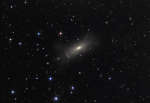
Similar in size to the Milky Way, elliptical galaxy NGC 7600 is about 150 thousand light-years distant. In this deep image, spanning about 1/2 degree on the sky toward the constellation Aquarius, NGC 7600 sports a remarkable outer halo of nested shells and broad circumgalactic structures.
 Signals of a Strange Universe
29.03.2009
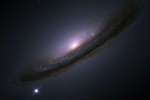
Eleven years ago results were first presented indicating that most of the energy in our universe is not in stars or galaxies but is tied to space itself. In the language of cosmologists, a large cosmological constant is directly implied by new distant supernovae observations.
|
January February March April May June July August September October |
|||||||||||||||||||||||||||||||||||||||||||||||||