
|
You entered: explorer 1
 A Cosmic Snowball
30.05.1997
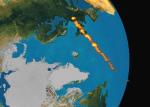
Like cosmic snowballs, fluffy comet-like objects the size of houses and composed mostly of water-ice, may be pummeling planet Earth 5 to 30 times a minute. This controversial theory was originally proposed in 1986 by Dr. Louis Frank (U. Iowa) based on data from NASA's Dynamics Explorer 1.
 Approaching Asteroid Ceres
19.01.2015
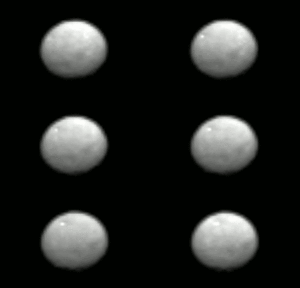
It is the largest asteroid in the asteroid belt -- what secrets does it hold? To find out, NASA has sent the robotic Dawn spacecraft to explore and map this cryptic 1,000-kilometer wide world: Ceres. Orbiting between Mars and Jupiter, Ceres is officially categorized as a dwarf planet but has never been imaged in detail.
 The First Explorer
12.08.2006
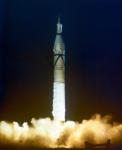
Inaugurating the era of space exploration for the US, the First Explorer, a thirty pound satellite, was launched into Earth orbit on February 1, 1958 by the Army Ballistic Missle Agency. Explorer I carried instruments to measure temperatures, micrometeorite impacts, and an experiment designed by James A.
 ALMA Milky Way
24.07.2014
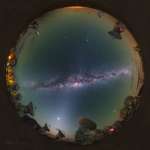
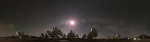
This alluring all-skyscape was taken 5,100 meters above sea level, from the Chajnantor Plateau in the Chilean Andes. Viewed through the site's rarefied atmosphere at about 50% sea level pressure, the gorgeous Milky Way stretches through the scene.
 The View from Chajnantor
23.11.2011
From an altitude of over 5,000 meters, the night sky view from Chajnantor Plateau in the Chilean Andes is breathtaking in more ways than one. The dark site's rarefied atmosphere, at about 50 percent sea level pressure, is also extremely dry.
 Star Formation in the Tadpole Nebula
7.05.2017
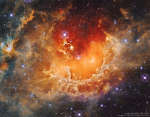
What's all of the commotion in the Tadpole nebula? Star formation. Dusty emission in the Tadpole nebula, IC 410, lies about 12,000 light-years away in the northern constellation of the Charioteer (Auriga).
 Primordial Contact Binary 2014 MU69
22.05.2019
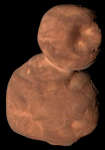
Primordial contact binary 2014 MU69, also known as Ultima Thule, really is very red. In fact, it's the reddest outer solar system object ever visited by a spacecraft from Earth. Its reddish hue is believed to be due to organic materials on its surface.
 Herschel s Orion
14.10.2016
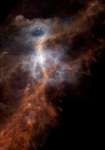
This dramatic image peers within M42, the Orion Nebula, the closest large star-forming region. Using data at infrared wavelengths from the Herschel Space Observatory, the false-color composite explores the natal cosmic cloud a mere 1,500 light-years distant.
 Human as Spaceship
15.08.2016
You are a spaceship soaring through the universe. So is your dog. We all carry with us trillions of microorganisms as we go through life. These multitudes of bacteria, fungi, and archaea have different DNA than you. Collectively called your microbiome, your shipmates outnumber your own cells.
 SDO: The Extreme Ultraviolet Sun
23.04.2010
Don't panic, the Sun has not gone wild. But this wild-looking portrait of the nearest star to planet Earth was made on March 30th by the recently launched Solar Dynamics Observatory (SDO). Shown in false-color, the composite view covers extreme ultraviolet wavelengths and traces hot plasma at temperatures approaching 1 million kelvins.
|
January February March April May June July August September October |
|||||||||||||||||||||||||||||||||||||||||||||||||