
|
You entered: globule
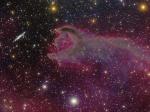 CG4: A Ruptured Cometary Globule
14.03.2006
Can a gas cloud eat a galaxy? It's not even close. The odd looking "creature" in the center of the above photo is a gas cloud known as a cometary globule. This globule, however, has ruptured. Cometary globules are typically characterized by dusty heads and elongated tails.
 An Unusual Globule in IC 1396
12.12.2022
Is there a monster in IC 1396? Known to some as the Elephant's Trunk Nebula, parts of gas and dust clouds of this star formation region may appear to take on foreboding forms, some nearly human. The only real monster here, however, is a bright young star too far from Earth to hurt us.
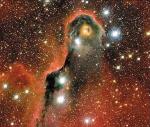 An Unusual Globule in IC 1396
25.03.2002
Is there a monster in IC 1396? Known to some as the Elephant's Trunk Nebula, parts of gas and dust clouds of this star formation region may appear to take on foreboding forms, some nearly human. The only real monster here, however, is a bright young star too far from Earth to hurt us.
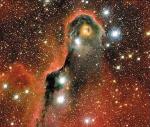 An Unusual Globule in IC 1396
19.10.2003
Is there a monster in IC 1396? Known to some as the Elephant's Trunk Nebula, parts of gas and dust clouds of this star formation region may appear to take on foreboding forms, some nearly human. The only real monster here, however, is a bright young star too far from Earth to hurt us.
 An Unusual Globule in IC 1396
14.04.2014
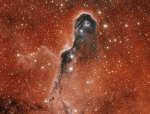
Is there a monster in IC 1396? Known to some as the Elephant's Trunk Nebula, parts of gas and dust clouds of this star formation region may appear to take on foreboding forms, some nearly human. The only real monster here, however, is a bright young star too far from Earth to hurt us.
 APOD: 2024 May 21 Б CG4: The Globule and the Galaxy
21.05.2024
Can a gas cloud eat a galaxy? It's not even close. The "claw" of this odd looking "creature" in the featured photo is a gas cloud known as a cometary globule. This globule, however, has ruptured. Cometary globules are typically characterized by dusty heads and elongated tails.
 Cometary Globule CG4
5.03.2015
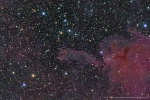
The faint and somehow menacing cometary globule CG4 reaches through the center of this deep southern skyscape. About 1,300 light-years from Earth toward the constellation Puppis, its head is about 1.5 light-years in diameter and its tail about 8 light-years long.
 APOD: 2026 March 11 Б CG 4: The Globule and the Galaxy
11.03.2026
Is this a cosmic monster ready to devour an unsuspecting galaxy? Thankfully, that is not the case. The red БmonsterБ shown in the featured image is Cometary Globule CG 4, 1,300 light-years away in the Constellation Puppis.
 A Radio Vista of Cygnus
18.02.2002
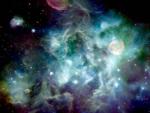
Shells of ancient supernovas, cocoons surrounding newborn stars, and specks from distant quasars highlight this tremendous vista toward the constellation of Cygnus. The representative color image covers about 10 degrees across on the sky but is only a small part of the Canadian Galactic Plane Survey in radio light.
 The Dark Tower in Scorpius
15.07.2021
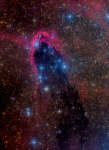
In silhouette against a crowded star field along the tail of the arachnalogical constellation Scorpius, this dusty cosmic cloud evokes for some the image of an ominous dark tower. In fact, clumps of dust...
|
January February March April May June July August September October |
|||||||||||||||||||||||||||||||||||||||||||||||||