
|
You entered: kepler
 Kepler s House in Linz
15.05.2018
Four hundred years ago today (May 15, 1618) Johannes Kepler discovered the simple mathematical rule governing the orbits of the solar system's planets, now recognized as Kepler's Third Law of planetary motion.
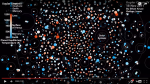 Kepler Orrery IV
5.12.2015
The exoplanet hunting Kepler mission's total for candidate and confirmed multiple planet systems stands at 1,705 worlds in orbit around 685 distant stars. Put all of those exoplanet orbits on the same scale and follow their relative orbital motions to get Kepler Orrery IV.
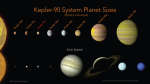 The Kepler 90 Planetary System
18.12.2017
Do other stars have planetary systems like our own? Yes -- one such system is Kepler-90. Cataloged by the orbiting Kepler satellite, an eighth planet has now been discovered giving Kepler-90 the same number of known planets as our Solar System.
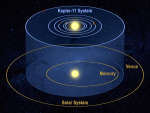 Six Worlds for Kepler 11
3.02.2011
Six worlds orbit Kepler-11, a sunlike star 2,000 light-years distant in the constellation Cygnus. The new discovery, based on data from NASA's planet hunting Kepler spacecraft, makes the Kepler-11 system the fullest exoplanetary system known.
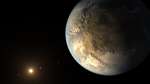 Earth size Kepler 186f
19.04.2014
Planet Kepler-186f is the first known Earth-size planet to lie within the habitable zone of a star beyond the Sun. Discovered using data from the prolific planet-hunting Kepler spacecraft, the distant world orbits...
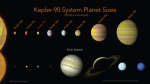 The Kepler 90 Planetary System
28.04.2020
Do other stars have planetary systems like our own? Yes -- one such system is Kepler-90. Cataloged by the Kepler satellite that operated from Earth orbit between 2009 and 2018, eight planets were discovered, giving Kepler-90 the same number of known planets as our Solar System.
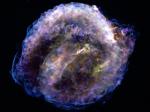 Keplers Supernova Remnant in X Rays
16.01.2007
What caused this mess? Some type of star exploded to create the unusually shaped nebula known as Kepler's supernova remnant, but which type? Light from the stellar explosion that created this energized cosmic cloud was first seen on planet Earth in October 1604, a mere four hundred years ago.
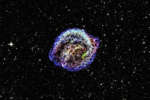 Kepler's Supernova Remnant in X Rays
15.05.2013
What caused this mess? Some type of star exploded to create the unusually shaped nebula known as Kepler's supernova remnant, but which type? Light from the stellar explosion that created this energized cosmic cloud was first seen on planet Earth in October 1604, a mere four hundred years ago.
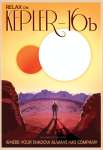 Where Your Shadow Has Company
20.02.2016
Want to take a relaxing interstellar vacation? Consider visiting Kepler-16b, a world in a binary star system. In fact Kepler-16b is the first discovered circumbinary planet. It was detected in a wide 229 day orbit around a close pair of cool, low-mass stars some 200 light-years away.
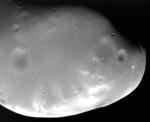 Deimos: A Small Martian Moon
2.09.2001
Mars has two tiny moons, Phobos and Deimos. Pictured above is Deimos, the smaller moon of Mars. In fact, Deimos is one of the smallest known moons in the Solar System measuring only nine miles across.
|
January February March April May June July August September |
|||||||||||||||||||||||||||||||||||||||||||||||||