
|
You entered: nova
 APOD: 2024 April 30 Б GK Per: Nova and Planetary Nebula
30.04.2024
The star system GK Per is known to be associated with only two of the three nebulas pictured. At 1500 light years distant, Nova Persei 1901 (GK Persei) was the second closest nova yet recorded. At the very center is a white dwarf star, the surviving core of a former Sun-like star.
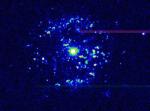 T Pyxidis: Recurrent Nova
25.09.1997
What happens when a thermonuclear blast occurs on the surface of a white dwarf star? Over the years astronomers have watched (at a safe distance ...) as, 6,000 light years from Earth in the southern constellation Pyxis, a binary star known as T Pyxidis repeatedly produces these fearsome explosions.
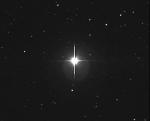 Introducing Nova Velorum 1999
24.05.1999
A bright nova was discovered Saturday that is currently visible to the unaided eye in southern skies. Nova Velorum 1999 was recorded near visual magnitude 3 independently by discoverers Peter Williams and Alan C. Gilmore (Mt. John U. Obs.), making it more luminous than many famous bright stars.
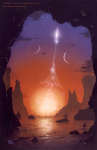 Dawn Before Nova
17.11.2009
Will this dawn bring another nova? Such dilemmas might be pondered one day by future humans living on a planet orbiting a cataclysmic variable binary star system. Cataclysmic variables involve gas falling from a large star onto an accretion disk surrounding a massive but compact white dwarf star.
 APOD: 2025 July 3 Б Nova V462 Lupi Now Visible
3.07.2025
If you know where to look, you can see a thermonuclear explosion from a white dwarf star. Possibly two. Such explosions are known as novas and the detonations are currently faintly visible with the unaided eye in Earth's southern hemisphere -- but are more easily seen with binoculars.
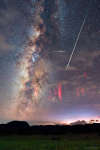 Perseid Meteor, Red Sprites, and Nova RS Oph
16.08.2021
This was an unusual sky. It wasn't unusual because of the central band the Milky Way Galaxy, visible along the image left. Most dark skies show part of the Milky Way. It wasn't unusual because of the bright meteor visible on the upper right.
 A Bright Nova in Cassiopeia
7.06.2021
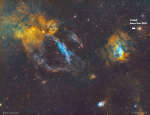
WhatБs that new spot of light in Cassiopeia? A nova. Although novas occur frequently throughout the universe, this nova, known as Nova Cas 2021 or V1405 Cas, became so unusually bright in the skies of Earth last month that it was visible to the unaided eye.
 GK Per: Nova of 1901
5.11.2011
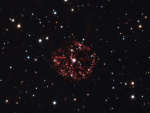
Early in the 20th century, GK Persei briefly became one of the brightest stars in planet Earth's sky, an event known as Nova Persei 1901. Documented in this modern day composite of two images from 2003 and 2011 the ejecta from the explosion, popularly called the Firework Nebula, continues to expand into space.
 Naked Eye Nova Centauri 2013
7.12.2013
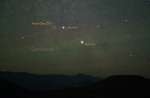
Brightest stellar beacons of the constellation Centaurus, Alpha and Beta Centauri are easy to spot from the southern hemisphere. For now, so is new naked eye Nova Centauri 2013. In this night skyscape recorded...
 A Nova In Aquila
15.12.1999
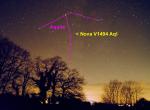
On December 1st, experienced observers patroling the night sky with binoculars noticed what seemed to be a new star in the constellation of Aquila (The Eagle). It wasn't really a new star though.
|
January February March April May June July August September October |
|||||||||||||||||||||||||||||||||||||||||||||||||