
|
You entered: shock wave
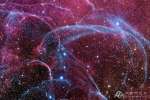 Filaments of the Vela Supernova Remnant
1.10.2013
The explosion is over but the consequences continue. About eleven thousand years ago a star in the constellation of Vela could be seen to explode, creating a strange point of light briefly visible to humans living near the beginning of recorded history.
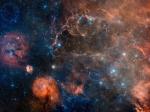 Vela Supernova Remnant in Visible Light
13.02.2007
The explosion is over but the consequences continue. About eleven thousand years ago a star in the constellation of Vela could be seen to explode, creating a strange point of light briefly visible to humans living near the beginning of recorded history.
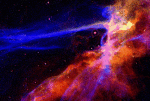 Rampaging Fronts of the Veil Nebula
7.03.1996
A supernova explosion of a high-mass star results in fast moving blast waves. At the front of the waves shown above, ionized gas in the Veil Supernova Remnant rushes out from the explosion, sweeps up material, and breaks up many atoms into constituent ions and electrons.
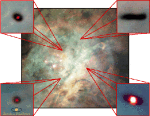 Planetary Systems Now Forming in Orion
7.12.1996
How do planets form? Astronomers are finding out by studying one of the most interesting of all astronomical nebulae known, the Great Nebula in Orion. Insets to above mosaic show several planetary systems in formation. The bottom left insert shows the relative size of our own Solar System. The Orion Nebula contains many stellar nurseries.
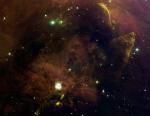 A Panorama of Oddities in Orion A
13.03.2000
New stars, fast jets, and shocked gas clouds all occupy Orion A, a giant molecular cloud just south of the Orion Nebula. The bright object visible below and slightly left of center of this recently released picture is the reflection nebula NGC 1999.
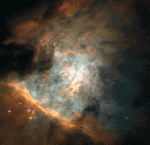 M42: Orion Nebula Mosaic
21.11.1995
The Great Nebula in Orion is one of the most interesting of all astronomical nebulae known. Here fifteen pictures from the Hubble Space Telescope have been merged to show the great expanse and diverse nature of the nebula.
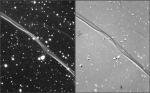 SN 1006: Historys Brightest Supernova
17.03.2003
Suddenly, in the year 1006 AD, a new star appeared in the sky. Over the course of just a few days, the rogue star became brighter than the planet Venus. The star, likely...
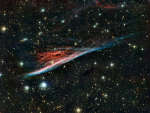 NGC 2736: The Pencil Nebula
24.09.2012
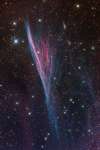
This shock wave plows through space at over 500,000 kilometers per hour. Moving toward to bottom of this beautifully detailed color composite, the thin, braided filaments are actually long ripples in a sheet of glowing gas seen almost edge on. Cataloged as NGC 2736, its narrow appearance suggests its popular name, the Pencil Nebula.
 NGC 2736: The Pencil Nebula
8.01.2009
This shock wave plows through space at over 500,000 kilometers per hour. Moving right to left in the beautifully detailed color composite, the thin, braided filaments are actually long ripples in a sheet of glowing gas seen almost edge on. Cataloged as NGC 2736, its narrow appearance suggests its popular name, the Pencil Nebula.
 Supernova Remnant E0102 72 from Radio to X-Ray
14.04.2000
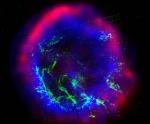
Not all stars form a big Q after they explode. The shape of supernova remnant E0102-72, however, is giving astronomers a clue about how tremendous explosions disperse elements and interact with surrounded gas. The above image is a composite of three different photographs in three different types of light.
|
January February March April May June July August September October |
|||||||||||||||||||||||||||||||||||||||||||||||||