
|
You entered: supernova remnant
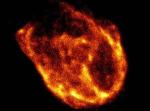 Supernova Remnant N132D in X Rays
13.09.1999
Thousands of years after a star explodes, an expanding remnant may still glow brightly. Such is the case with N132D, a supernova remnant located in the neighboring Large Magellanic Cloud galaxy. The expanding shell from this explosion now spans 80 light-years and has swept up about 600 Suns worth of mass.
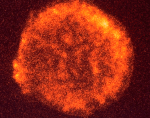 Tychos Supernova Remnant in X ray
7.03.1999
How often do stars explode? By looking at external galaxies, astronomers can guess that these events, known as a supernovae, should occur about once every 30 years in a typical spiral galaxy like our MilkyWay.
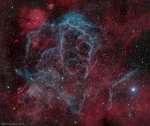 Vela Supernova Remnant
10.09.2010
The plane of our Milky Way Galaxy runs through this complex and beautiful skyscape. At the northwestern edge of the constellation Vela (the Sails) the four frame mosaic is over 10 degrees wide, centered on the glowing filaments of the Vela Supernova Remnant, the expanding debris cloud from the death explosion of a massive star.
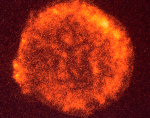 Tycho's Supernova Remnant in X-ray
23.06.1996
How often do stars explode? By looking at external galaxies, astronomers can guess that these events, known as a supernovae, should occur about once every 30 years in a typical spiral galaxy like our MilkyWay.
 APOD: 2024 September 18 Б The Mermaid Nebula Supernova Remnant
18.09.2024
New stars are born from the remnants of dead stars. The gaseous remnant of the gravitational collapse and subsequent death of a very massive star in our Milky Way created the G296.5+10.0 supernova remnant, of which the featured Mermaid Nebula is part.
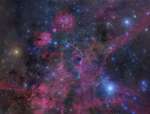 Vela Supernova Remnant
6.03.2008
The plane of our Milky Way Galaxy runs through this complex and beautiful skyscape. At the northwestern edge of the constellation Vela (the Sails) the 16 degree wide, 30 frame mosaic is centered on the glowing filaments of the Vela Supernova Remnant, the expanding debris cloud from the death explosion of a massive star.
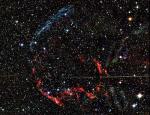 Galactic Supernova Remnant IC 443
21.07.1999
About 8000 years ago, a star in our Galaxy exploded. Ancient humans might have noticed the supernova as a temporary star, but modern humans can see the expanding shell of gas even today.
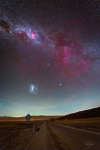 The Gum Nebula Supernova Remnant
29.11.2022
Because the Gum Nebula is the closest supernova remnant, it is actually hard to see. Spanning 40 degrees across the sky, the nebula appears so large and faint that it is easily lost in the din of a bright and complex background.
 Four Supernova Remnants
28.07.2006
These four panels show x-ray images of expanding cosmic debris clouds, tens of light-years across, in nearby galaxy the Large Magellanic Cloud. The supernova remnants (SNRs) are the results of two types of stellar...
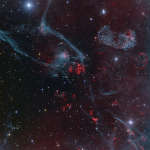 Puppis A Supernova Remnant
29.09.2017
Driven by the explosion of a massive star, supernova remnant Puppis A is blasting into the surrounding interstellar medium about 7,000 light-years away. At that distance, this colorful telescopic field based on broadband and narrowband optical image data is about 60 light-years across.
|
January February March April May June July August September October |
|||||||||||||||||||||||||||||||||||||||||||||||||