
|
You entered: Earth's atmosphere
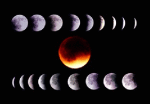 Tonight: A Total Lunar Eclipse
26.09.1996
Tonight brings the last total lunar eclipse visible from North America until the year 2000 - with the Moon becoming completely immersed in Earth's shadow. The above time-lapse photograph shows a lunar eclipse that occurred in April 1993.
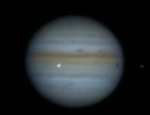 Video: Flash on Jupiter
17.09.2021
There has been a flash on Jupiter. A few days ago, several groups monitoring our Solar System's largest planet noticed a two-second long burst of light. Such flashes have been seen before, with the most famous being a series of impactor strikes in 1994.
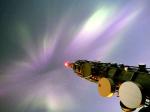 Aurora Over a Communications Tower
28.09.2004
Higher than highest communications tower, higher than highest mountain, higher than highest airplane, lies the realm of the aurora. Auroras rarely reach below 60 kilometers, and can range up to 1000 kilometers. Aurora light results from energetic electrons and protons striking molecules in the Earth's atmosphere.
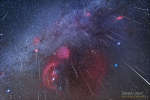 Geminids and Friends
15.12.2018
From a radiant in the constellation of the Twins, the annual Geminid meteor shower rained down on our fair planet this week. This beautiful skyscape collects about 70 of Gemini's lovely shooting stars in a digital composition made from multiple exposures.
 Circling the Sun
13.01.2024
Earth's orbit around the Sun is not a circle, it's an ellipse. The point along its elliptical orbit where our fair planet is closest to the Sun is called perihelion. This year...
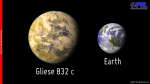 Gliese 832c: The Closest Potentially Habitable Exoplanet
9.07.2014
This planet is only 16 light years away -- could it harbor life? Recently discovered exoplanet Gliese 832c has been found in a close orbit around a star that is less bright than our Sun.
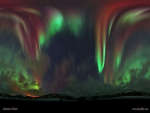 A Full Sky Aurora Over Norway
1.01.2017
Higher than the highest building, higher than the highest mountain, higher than the highest airplane, lies the realm of the aurora. Auroras rarely reach below 60 kilometers, and can range up to 1000 kilometers. Aurora light results from energetic electrons and protons striking molecules in the Earth's atmosphere.
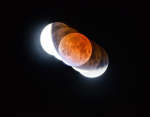 At the Shadow s Edge
25.11.2021
Shaped like a cone tapering into space, the Earth's dark central shadow or umbra has a circular cross-section. It's wider than the Moon at the distance of the Moon's orbit though. But during the lunar eclipse of November 18/19, part of the Moon remained just outside the umbral shadow.
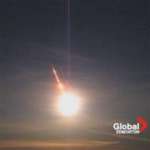 Fireball Over Edmonton
25.11.2008
What if you're driving down the street and an object from space shoots across the sky right in front of you? Such was the case last week for many people in south central Canada.
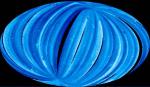 EUVE Sky Map
31.01.2002
The stars beyond the Sun and the distant galaxies should be undetectable at extreme ultraviolet wavelengths. At least that was the conventional wisdom when it was first realized that the space between the stars is filled with hydrogen, a strong absorber of extreme ultraviolet light.
|
January February March April May June July August September October |
|||||||||||||||||||||||||||||||||||||||||||||||||