
|
You entered: Jupiter's Moons
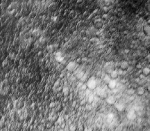 The Crater Chain
15.07.1995
NASA's robot spaceprobe Voyager 1, took this closeup image of the surface of Jupiter's crater scarred moon Callisto in 1979. A mysterious chain of craters is seen to extend diagonally across the image (upper left to lower right). What could cause the craters to line up in such a regular fashion?
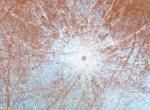 Pwyll: Icy Crater of Europa
17.04.1997
The impact crater Pwyll (a name from Celtic Mythology) is thought to represent one of the youngest features on the surface of Jupiter's moon Europa. A combination of color and high resolution black...
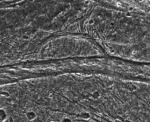 Mysterious Features on Ganymede
9.12.1997
Where is the rest of the circle? Jupiter's largest moon Ganymede has some truly unusual terrain, including the pictured half circle above cut by nearly parallel curves. Full circles can be easily explained by impact craters, but partial circles imply that some resurfacing has occurred since the original impact.
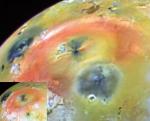 Dark Volcano Active on Io
10.11.1997
The surface of Io is changing even as we watch. The inset frame of Jupiter's most active moon was taken by the robot spacecraft Galileo in April. Just last month the larger image was taken. The new large black spot reveals that a volcano named Pillan Patera has been erupting during the interim.
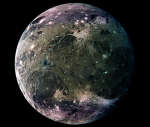 Ganymede Enhanced
20.09.2009
What does the largest moon in the Solar System look like? Ganymede, larger than even Mercury and Pluto, has a surface speckled with bright young craters overlying a mixture of older, darker, more cratered terrain laced with grooves and ridges.
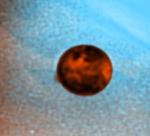 Eruption on Io
23.06.1997
There it goes again. Gas and rock were catapulted hundreds of kilometers into space as Jupiter's most volatile moon, Io, showed yet another impressive volcanic display in this just-released photograph by the Hubble Space Telescope.
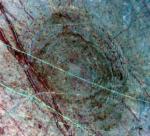 Impact on Europa
15.08.1997
This bull's-eye pattern marks the impact of a mountain-sized comet or asteroid on the icy surface of Jupiter's moon Europa. Recorded by the Galileo spacecraft in April of this year, the composite false color image clearly reveals the telltale concentric fractures which cover about
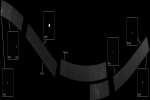 The Solar System from MESSENGER
23.02.2011
If you looked out from the center of the Solar System, what would you see? Nearly such a view was taken recently from the MESSENGER spacecraft currently orbiting the Sun from the distance of Mercury. The Sun's planets all appear as points of light, with the closest and largest planets appearing the brightest.
 Pwyll: Icy Crater of Europa
13.04.2002
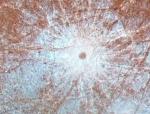
The impact crater Pwyll (a name from Celtic Mythology) is thought to represent one of the youngest features on the surface of Jupiter's moon Europa. A combination of color and high resolution black...
 Cracks and Ridges on Europa
2.06.2002
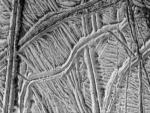
Which way to the interstate? What appears to be a caricature of a complex highway system on Earth is actually a system of ridges and cracks on the icy surface of Jupiter's moon Europa. The distance between parallel ridges in the above photograph is typically about 1 kilometer.
|
January February March April May June July August September |
|||||||||||||||||||||||||||||||||||||||||||||||||