
|
You entered: Ring Nebula
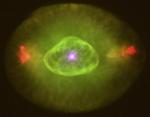 NGC 6826: The Blinking Eye
26.05.2001
The colorful planetary nebula phase of a sun-like star's life is brief. Almost in the "blink of an eye" - cosmically speaking - the star's outer layers are cast off, forming an expanding emission nebula. This nebula lasts perhaps 10 thousand years compared to a 10 billion year stellar life span.
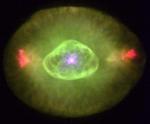 NGC 6826: The Blinking Eye
19.12.1997
The colorful planetary nebula phase of a sun-like star's life is brief. Almost in the "blink of an eye" - cosmically speaking - the star's outer layers are cast off, forming an expanding emission nebula. This nebula lasts perhaps 10 thousand years compared to a 10 billion year stellar life span.
 Light from the Heart Nebula
3.10.2006
What powers the Heart Nebula? The large emission nebula dubbed IC 1805 looks, in whole, like a human heart. The nebula glows brightly in red light emitted by its most prominent element: hydrogen. The red glow and the larger shape are all created by a small group of stars near the nebula's center.
 APOD: 2025 March 5 Б Seven Sisters versus California
5.03.2025
On the right, dressed in blue, is the Pleiades. Also known as the Seven Sisters and M45, the Pleiades is one of the brightest and most easily visible open clusters on the sky. The Pleiades contains over 3,000 stars, is about 400 light years away, and only 13 light years across.
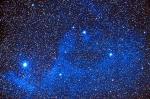 Starlight Reflections
14.04.1998
Wisps of dust fill the space between the stars. This dust is usually invisible, subtly acting to dim the light of more distant stars. Sometimes this dust is thick and prominent as dark patches on otherwise bright emission nebulae. Other times this dust may show itself by reflecting the light of bright, nearby stars.
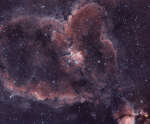 IC 1805: The Heart Nebula in HDR
25.10.2011
What powers the Heart Nebula? The large emission nebula dubbed IC 1805 looks, in whole, like a human heart. The nebula glows brightly in red light emitted by its most prominent element: hydrogen. The red glow and the larger shape are all created by a small group of stars near the nebula's center.
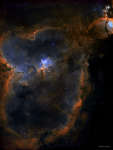 Bright from the Heart Nebula
27.10.2015
What's that inside the Heart Nebula? First, the large emission nebula dubbed IC 1805 looks, in whole, like a human heart. The nebula glows brightly in red light emitted by its most prominent element: hydrogen.
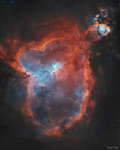 IC 1805: The Heart Nebula
11.09.2019
What energizes the Heart Nebula? First, the large emission nebula dubbed IC 1805 looks, in whole, like a human heart. The nebula glows brightly in red light emitted by its most prominent element: hydrogen. The red glow and the larger shape are all powered by a small group of stars near the nebula's center.
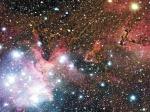 In the Center of the Heart Nebula
8.12.2004
What powers the Heart Nebula? The large emission nebula dubbed IC 1805 looks, in whole, like a human heart. The nebula glows brightly in red light emitted by its most prominent element: hydrogen. The red glow and the larger shape are all created by a small group of stars near the nebula's center.
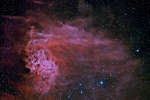 AE Aurigae and the Flaming Star Nebula
26.01.2009
Is star AE Aurigae on fire? No. Even though AE Aurigae is named the flaming star, the surrounding nebula IC 405 is named the Flaming Star Nebula, and the region appears to harbor red smoke, there is no fire.
|
January February March April May June July August September October |
|||||||||||||||||||||||||||||||||||||||||||||||||