
|
You entered: deep field
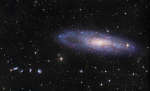 NGC 247 and Friends
30.03.2018
About 70,000 light-years across, NGC 247 is a spiral galaxy smaller than our Milky Way. Measured to be only 11 million light-years distant it is nearby though. Tilted nearly edge-on as seen from our perspective, it dominates this telescopic field of view toward the southern constellation Cetus.
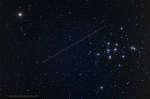 Close Encounter with M44
28.01.2015
On Monday, January 26, well-tracked asteroid 2004 BL86 made its closest approach, a mere 1.2 million kilometers from our fair planet. That's about 3.1 times the Earth-Moon distance or 4 light-seconds away. Moving...
APOD: 2026 July 29 Б Psyche Receives Gravity Assist from Mars
29.07.2026
Solar System bodies make deep space exploration more fuel efficient! TodayБs video shows the Psyche spacecraft gaining speed and changing its trajectory with minimal fuel spent due to a gravity assist from Mars in May 2026. Mars has an average orbital speed of almost 87,000 km/h (54,000 mph) around the Sun.
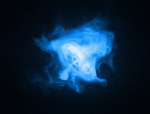 Crab Pulsar Wind Nebula
27.12.2008
The Crab Pulsar, a city-sized, magnetized neutron star spinning 30 times a second, lies at the center of this remarkable image from the orbiting Chandra Observatory. The deep x-ray image gives the first clear view of the convoluted boundaries of the Crab's pulsar wind nebula.
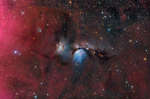 M78 Wide Field
29.12.2017
Interstellar dust clouds and glowing nebulae abound in the fertile constellation of Orion. One of the brightest, M78, is centered in this colorful, wide field view, covering an area north of Orion's belt. At a distance of about 1,500 light-years, the bluish reflection nebula is around 5 light-years across.
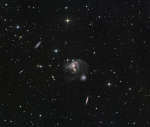 Hickson 91 in Piscis Austrinus
24.03.2016
Scanning the skies for galaxies, Canadian astronomer Paul Hickson and colleagues identified some 100 compact groups of galaxies, now appropriately called Hickson Compact Groups (HCGs). This sharp telescopic image captures one such galaxy group, HCG 91, in beautiful detail.
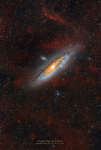 Clouds of Andromeda
4.01.2017
The beautiful Andromeda Galaxy is often imaged by planet Earth-based astronomers. Also known as M31, the nearest large spiral galaxy is a familiar sight with dark dust lanes, bright yellowish core, and spiral arms traced by blue starlight.
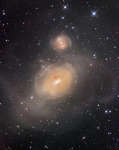 NGC 1316: After Galaxies Collide
2.02.2017
An example of violence on a cosmic scale, enormous elliptical galaxy NGC 1316 lies about 75 million light-years away toward Fornax, the southern constellation of the Furnace. Investigating the startling sight, astronomers suspect the giant galaxy of colliding with smaller neighbor NGC 1317 seen just above, causing far flung loops and shells of stars.
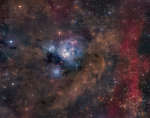 Young Suns of NGC 7129
16.10.2025
Young suns still lie within dusty NGC 7129, some 3,000 light-years away toward the royal constellation Cepheus. While these stars are at a relatively tender age, only a few million years old, it is likely that our own Sun formed in a similar stellar nursery around five billion years ago.
 M78 Wide Field
26.11.2009
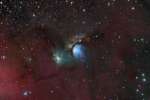
Interstellar dust clouds and glowing nebulae abound in the fertile constellation of Orion. One of the brightest, M78, is centered in this colorful, wide field view, covering an area north of Orion's belt. At a distance of about 1,500 light-years, the bluish reflection nebula is around 5 light-years across.
|
January February March April May June July August September |
|||||||||||||||||||||||||||||||||||||||||||||||||