
|
You entered: early universe
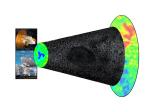 Huge Void Implicated in Distant Universe
27.08.2007
What has created this huge empty area in the universe? No one is yet sure, and even the extent of the estimated billion-light year void is being researched. The void is not a hole...
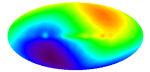 COBE Dipole: Speeding Through the Universe
8.03.1997
Our Earth is not at rest. The Earth moves around the Sun. The Sun orbits the center of the Milky Way Galaxy. The Milky Way Galaxy orbits in the Local Group. The Local Group falls toward the Virgo Cluster of Galaxies.
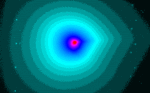 Near Comet Hyakutake's Nucleus
21.03.1996
This March 19th false-color picture of Comet Hyakutake from one of the most sophisticated ground based telescopes captures the area surrounding the comet's nucleus. A comet's nucleus - not directly visible here - is a solid dirty iceball probably no more than 10 kilometers across.
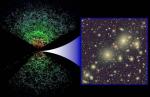 The SDSS 3D Universe Map
28.10.2003
The latest map of the cosmos again indicates that dark matter and dark energy dominate our universe. The Sloan Digital Sky Survey (SDSS) is on its way to measuring the distances to over one million galaxies.
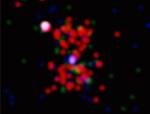 3C294: Distant X Ray Galaxy Cluster
22.02.2001
Large clusters of galaxies are the most massive objects in the universe. Astronomers now realize that a hallmark of these cosmic behemoths are gas clouds with temperatures of tens of millions of degrees that pervade the clusters and radiate strongly in x-rays.
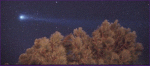 Comet Hyakutake and a Tree
10.04.1996
Comet Hyakutake is still visible as it continues its orbit around the Sun. The comet will brighten again in late April and early May. The above fascinating picture was taken with a three minute exposure. In the middle of the exposure, the photographer cleverly set off a flash, momentarily illuminating the foreground tree.
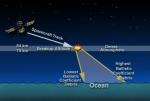 Compton Reentry
3.06.2000
Nine years ago the massive Compton Gamma Ray Observatory, the second of NASA's space-based great observatories, was deployed in low earth orbit. Lofted above the protective atmosphere, Compton's instruments could explore the extreme high-energy Universe in gamma rays -- photons with 100,000 times or more the energy of visible light.
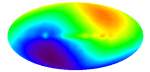 COBE Dipole: Speeding Through the Universe
5.02.1996
Our Earth is not at rest. The Earth moves around the Sun. The Sun orbits the center of the Milky Way Galaxy. The Milky Way Galaxy orbits in the Local Group. The Local Group falls toward the Virgo Cluster of Galaxies.
 APOD: 2025 December 1 Б 3I ATLAS: Tails of an Interstellar Comet
1.12.2025
How typical is our Solar System? Studying 3I/ATLAS, a comet just passing through, is providing clues. Confirmed previous interstellar visitors include an asteroid, a comet, a meteor, and a gas wind dominated by hydrogen and helium.
 Island Universe, Cosmic Sand
14.08.2021
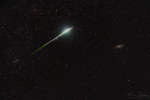
Stars in our own Milky Way Galaxy are scattered through this eye-catching field of view. From the early hours after midnight on August 13, the 30 second exposure of the night sky over Busko-Zdroj, Poland records the colorful and bright trail of a Perseid meteor.
|
January February March April May June July August September |
|||||||||||||||||||||||||||||||||||||||||||||||||