
|
You entered: giant star
 In the Center of Spiral Galaxy M83
6.11.2001
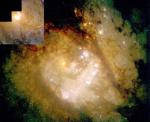
What's happening at the center of spiral galaxy M83? Just about everything, from the looks of it. M83, visible in the inset image on the upper left, is one of the closest spiral galaxies to our own Milky Way Galaxy and from a distance of 15 million light-years, appears to be relatively normal.
 Mars and the Star Clusters
19.04.2006
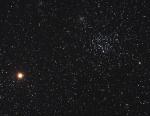
This evening's skyscape includes a view similar to this one, recorded in western skies on April 16 - an orange-hued planet Mars wandering near rich open star cluster M35. Also notable is fainter star cluster NGC 2158, just above and left of M35.
 In the Center of the Omega Nebula
1.05.2002
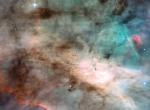
In the depths of the dark clouds of dust and molecular gas known as the Omega Nebula, stars continue to form. The above image from the Hubble Space Telescope's newly installed Advanced Camera for Surveys shows unprecedented detail in the famous star-forming region.
 The Large Cloud of Magellan
2.09.2004
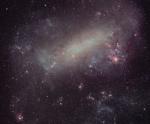
Portuguese navigator Fernando de Magellan and his crew had plenty of time to study the southern sky during the first circumnavigation of planet Earth. As a result, two fuzzy cloud-like objects easily visible for southern hemisphere skygazers are known as the Clouds of Magellan.
 APOD: 2025 July 19 Б Messier 6
19.07.2025
The sixth object in Charles Messier's famous catalog of things which are not comets, Messier 6 is a galactic or open star cluster. A gathering of 100 stars or so, all around 100 million years young, M6 lies some 1,600 light-years away toward the central Milky Way in the constellation Scorpius.
 The Tarantula Zone
26.04.2008
The Tarantula Nebula is more than 1,000 light-years in diameter -- a giant star forming region within our neighboring galaxy the Large Magellanic Cloud (LMC). That cosmic arachnid lies at the upper left of this expansive mosiac covering a part of the LMC over 6,000 light-years across.
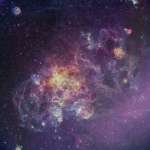 The Tarantula Zone
16.09.2009
The Tarantula Nebula is more than 1,000 light-years in diameter -- a giant star forming region within our neighboring galaxy the Large Magellanic Cloud (LMC). That cosmic arachnid lies left of center in this in this colorful telescopic image taken through narrow-band filters. It covers a part of the LMC over 2,000 light-years across.
 The Galactic Center in Infrared
17.01.2016
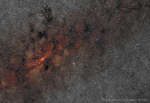
The center of our Galaxy is a busy place. In visible light, much of the Galactic Center is obscured by opaque dust. In infrared light, however, dust glows more and obscures less, allowing nearly one million stars to be recorded in the featured photograph.
 Messier 5
9.05.2019
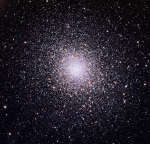
"Beautiful Nebula discovered between the Balance [Libra] & the Serpent [Serpens] ..." begins the description of the 5th entry in 18th century astronomer Charles Messier's famous catalog of nebulae and star clusters. Though it appeared...
 Moon Rays over Byurakan Observatory
26.09.2008
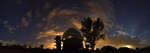
On September 7th, the first quarter Moon and passing clouds contributed to a dramatic night sky over the Byurakan Astrophysical Observatory. This panoramic view begins at the left looking toward the eastern horizon and the rising stars of the constellation Perseus.
|
January February March April May June July August |
||||||||||||||||||||||||||||||||||||||||||||||||||||||||