
|
You entered: molecules
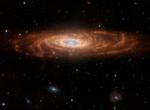 NGC 7331: A Galaxy So Inclined
1.07.2004
If our own Milky Way galaxy were 50 million light-years away with its disk inclined slightly to our line of sight, it would look a lot like large spiral galaxy NGC 7331. In fact...
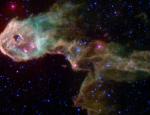 Inside The Elephant s Trunk
19.12.2003
Spectacular first images from the newly christened Spitzer Space Telescope include this penetrating interior view of an otherwise opaque dark globule known as the Elephant's Trunk Nebula. Seen in a composite of infrared...
 APOD: 2025 June 3 Б Rainbow Airglow over the Azores
3.06.2025
Why would the sky glow like a giant repeating rainbow? Airglow. Now, air glows all of the time, but it is usually hard to see. A disturbance however -- like an approaching storm -- may cause noticeable rippling in the Earth's atmosphere.
 The Sky from Mauna Kea
11.05.2015
What if you could stand at the top of a volcano and peer out across the universe? It the timing is right, you might see an amazing panorama like the one featured here.
 The Colors of Comet Hyakutake
29.03.1996
The colors of Comet Hyakutake are caused by the action of sunlight on the dust and gas produced by the warming nucleus. The microscopic dust particles reflect sunlight while the sun's ultraviolet radiation excites and ionizes the gas molecules causing them to glow or fluoresce in a range of visible colors.
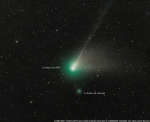 ZTF meets ATLAS
10.02.2023
Fading as it races across planet Earth's northern skies comet C/2022 E3 (ZTF) shares this telescopic frame with comet C/2022 U2 (ATLAS). Captured on the night of February 6 from a garden observatory in Germany's Bavarian Forest, the starry field of view toward the constellation Auriga spans about 2.5 degrees.
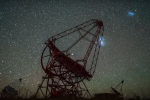 HESS Telescopes Explore the High Energy Sky
8.01.2019
They may look like modern mechanical dinosaurs but they are enormous swiveling eyes that watch the sky. The High Energy Stereoscopic System (H.E.S.S.) Observatory is composed of four 12-meter reflecting-mirror telescopes surrounding a larger telescope housing a 28-meter mirror.
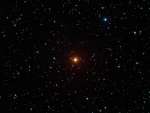 La Superba
18.12.2008
Y Canum Venaticorum (Y CVn) is a very rare star in planet Earth's night sky. It's also very red, exhibiting such a remarkable spectrum of light, 19th century astronomer Angelo Secchi dubbed it La Superba.
 APOD: 2023 September 6 Б HESS Telescopes Explore the High Energy Sky
6.09.2023
They may look like modern mechanical dinosaurs, but they are enormous swiveling eyes that watch the sky. The High Energy Stereoscopic System (H.E.S.S.) Observatory is composed of four 12-meter reflecting-mirror telescopes surrounding a larger telescope housing a 28-meter mirror.
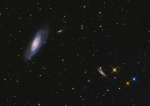 A View Toward M106
1.05.2020
Big, bright, beautiful spiral, Messier 106 dominates this cosmic vista. The nearly two degree wide telescopic field of view looks toward the well-trained constellation Canes Venatici, near the handle of the Big Dipper. Also...
|
January February March April May June July August |
||||||||||||||||||||||||||||||||||||||||||||||||||||||||