
|
You entered: north pole
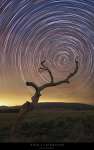 APOD: 2026 April 16 Б South Celestial Tree
16.04.2026
If you live in the northern hemisphere, you may have learned how to locate the North Star, Polaris, in the night sky. It can be used to find north, and it approximately marks the northern celestial pole.
 Geostationary Satellites Beyond the Alps
11.04.2012
Why don't those stars move? Stars in the sky will typically appear to rise and set as the Earth turns. Those far to the north or south will appear to circle the pole. If you look closely at the above time-lapse movie, however, there are points of light that appear stationary.
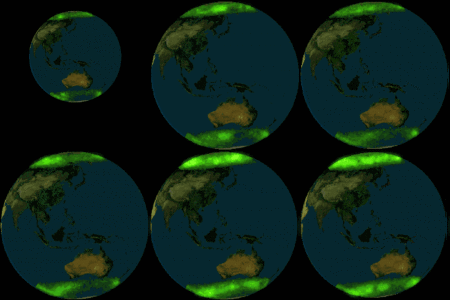 Auroras Over Both Earth Poles
14.11.2001
Auroras in the north and south can be nearly mirror images of each other. Such mirroring had been suspected for centuries but dramatically confirmed only last month by detailed images from NASA's orbiting Polar spacecraft.
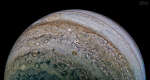 Complex Jupiter
5.06.2018
How complex is Jupiter? NASA's Juno mission to Jupiter is finding the Jovian giant to be more complicated than expected. Jupiter's magnetic field has been discovered to be much different from our Earth's simple dipole field, showing several poles embedded in a complicated network more convoluted in the north than the south.
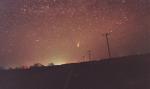 Comet Hale-Bopp is That Bright
27.02.1997
What's that fuzzy star? It's not a star, it's Comet Hale-Bopp. Not only has Comet Hale-Bopp become easy to see in the morning sky, it has become hard not to see it. It's that bright. Any morning just before sunrise, look towards the east.
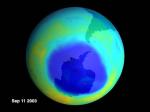 A Near Record Ozone Hole in 2003
6.10.2003
As expected, the ozone hole near Earth's South Pole is back again this year. This year's hole, being slightly larger than North America, is larger than last year but short of the record set on 2000 September 10. Ozone is important because it shields us from damaging ultraviolet sunlight.
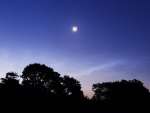 Night Shinings
2.07.2008
In the early morning hours of June 30th, ghostly clouds hovered in the east in this view of near dawn skies over western France. The noctilucent or night-shining clouds lie near the edge of space, reflecting sunlight from about 80 kilometers above Earth's surface.
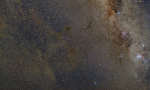 Sigma Octantis and Friends
28.06.2018
South pole star Sigma Octantis (of the constellation Octans) is on the left of this starry expanse spanning over 40 degrees across far southern skies. You'll have to look hard to find it, though.
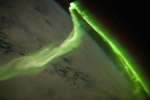 Above Aurora Australis
1.07.2010
On May 29, looking southward from a vantage point about 350 kilometers above the southern Indian Ocean, astronauts onboard the International Space Station watched this enormous, green ribbon shimmering below. Known as aurora australis...
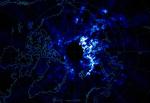 Night Shining Clouds
5.07.2007
Alluring noctilucent or night-shining clouds lie near the edge of space, some 80 kilometers above Earth's surface. Of course, when viewed from space the clouds are more properly called polar mesospheric clouds (PMCs) -- seen here for the first time in image data from the Aeronomy of Ice in the Mesosphere (AIM) satellite.
|
January February March April May June July August September October |
|||||||||||||||||||||||||||||||||||||||||||||||||