
|
You entered: red giant
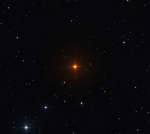 R Leporis: A Vampire's Star
31.10.2018
Better known as Hind's Crimson Star, R Leporis is a rare star in planet Earth's night sky. It's also a shocking shade of red. The star's discoverer, 19th century English...
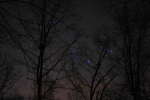 The Fainting of Betelgeuse
2.01.2020
Begirt with many a blazing star, Orion the Hunter is one of the most recognizable constellations. In this night skyscape the Hunter's stars rise in the northern hemisphere's winter sky on December 30, 2019, tangled in bare trees near Newnan, Georgia, USA.
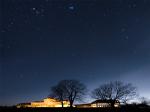 Mira Over Germany
21.02.2007
What's that new star in the sky? The star might appear new, but it's actually just the variable star Mira near its brightest. Rolling your cursor over the above vertically compressed image...
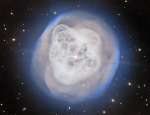 APOD: 2026 May 28 Б NGC 1514: The Crystal Ball Nebula
28.05.2026
What do you see in this crystal ball? The featured image shows NGC 1514, known as the Crystal Ball Nebula, observed by the Gemini North telescope on Maunakea, in Hawai'i. NGC 1514 is 1,500 light-years away and was discovered by William Herschel in 1790.
 The Clouds of Orion the Hunter
15.03.2015
Cradled in cosmic dust and glowing hydrogen, stellar nurseries in Orion the Hunter lie at the edge of giant molecular clouds some 1,500 light-years away. Spanning about 30 degrees, this breath-taking vista stretches across the well-known constellation from head to toe (left to right) and beyond.
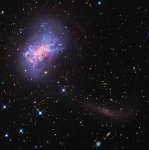 NGC 4449: Star Stream for a Dwarf Galaxy
26.01.2012
A mere 12.5 million light-years from Earth, irregular dwarf galaxy NGC 4449 lies within the confines of Canes Venatici, the constellation of the Hunting Dogs. About the size of our Milky Way's satellite...
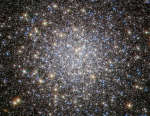 Hubble s Messier 5
4.11.2017
"Beautiful Nebula discovered between the Balance [Libra] & the Serpent [Serpens] ..." begins the description of the 5th entry in 18th century astronomer Charles Messier's famous catalog of nebulae and star clusters. Though it appeared...
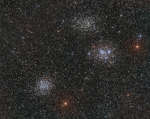 Three Clusters in Puppis
18.02.2022
Galactic or open star clusters are young. The swarms of stars are born together near the plane of the Milky Way, but their numbers steadily dwindle as cluster members are ejected by galactic tides and gravitational interactions.
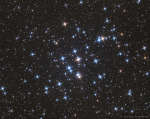 M44: The Beehive Cluster
30.04.2022
A mere 600 light-years away, M44 is one of the closest star clusters to our solar system. Also known as the Praesepe or the Beehive cluster its stars are young though, about 600 million years old compared to our Sun's 4.5 billion years.
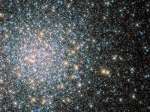 Hubble s Messier 5
25.04.2014
"Beautiful Nebula discovered between the Balance [Libra] & the Serpent [Serpens] ..." begins the description of the 5th entry in 18th century astronomer Charles Messier's famous catalog of nebulae and star clusters. Though it appeared...
|
January February March April May June July August September October |
|||||||||||||||||||||||||||||||||||||||||||||||||