
|
You entered: rings
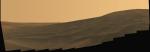 New Year Mars Panorama
5.01.2006
According to an Earth-based calendar, the Spirit rover spent the first day of 2006 gathering data to complete this panoramic view from Gusev crater on Mars. That day corresponded to Spirit's 710th Martian day or sol on the Red Planet.
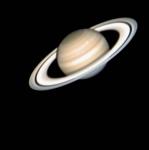 A New Storm on Saturn
27.01.2006
Presently at opposition in planet Earth's sky, Saturn is well placed for telescopic observations. On Wednesday two amateur astronomers took full advantage of the situation from Melun, near Paris, France. With...
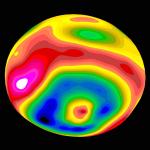 A Map of Asteroid Vesta
20.08.2006
Vesta is a huge rock 500 kilometers across that orbits out past Mars. In 1997, the above map of Vesta created using the Hubble Space Telescope was released showing a rugged surface highlighted by a single crater spanning nearly the entire length of the asteroid.
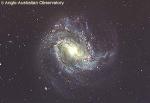 M83: A Barred Spiral Galaxy
26.09.1999
M83 is a bright spiral galaxy that can be found with a small telescope in the constellation of Hydra. It takes light about 15 million years to reach us from M83. M83 is quite a typical spiral - much like our own Milky Way Galaxy.
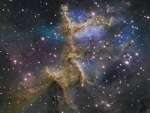 Central IC 1805
26.07.2008
Cosmic clouds seem to form fantastic shapes in the central regions of emission nebula IC 1805. Of course, the clouds are sculpted by stellar winds and radiation from massive hot stars in the nebula's newborn star cluster (aka Melotte 15).
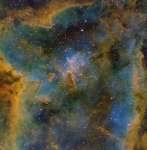 Melotte 15 in the Heart
25.09.2010
Cosmic clouds seem to form fantastic shapes in the central regions of emission nebula IC 1805. Of course, the clouds are sculpted by stellar winds and radiation from massive hot stars in the nebula's newborn star cluster, Melotte 15.
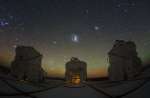 3 ATs
3 ATs
21.04.2012
Despite their resemblance to R2D2, these three are not the droids you're looking for. Instead, the enclosures house 1.8 meter Auxiliary Telescopes (ATs) at Paranal Observatory in the Atacama Desert region of Chile.
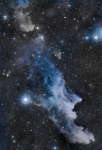 The Witch Head Nebula
30.10.2015
Double, double toil and trouble; Fire burn, and cauldron bubble .... maybe Macbeth should have consulted the Witch Head Nebula. A suggestively shaped reflection nebula, this cosmic crone is about 800 light-years away though. Its frightening visage seems to glare toward nearby bright star Rigel in Orion, just off the right edge of this frame.
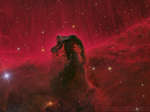 The Horsehead Nebula
17.12.2019
Sculpted by stellar winds and radiation, a magnificent interstellar dust cloud by chance has assumed this recognizable shape. Fittingly named the Horsehead Nebula, it is some 1,500 light-years distant, embedded in the vast Orion cloud complex.
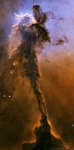 The Fairy of Eagle Nebula
25.09.2022
The dust sculptures of the Eagle Nebula are evaporating. As powerful starlight whittles away these cool cosmic mountains, the statuesque pillars that remain might be imagined as mythical beasts. Featured here is one of several striking dust pillars of the Eagle Nebula that might be described as a gigantic alien fairy.
|
January February March April May June July August September October |
|||||||||||||||||||||||||||||||||||||||||||||||||