
|
You entered: clouds
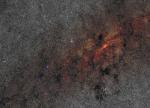 The Galactic Center in Infrared
16.07.2006
The center of our Galaxy is a busy place. In visible light, much of the Galactic Center is obscured by opaque dust. In infrared light, however, dust glows more and obscures less, allowing nearly one million stars to be recorded in the above photograph.
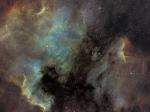 The North America and Pelican Nebulas
16.08.2006
Here are some familiar shapes in unfamiliar locations. This emission nebula on the left is famous partly because it resembles Earth's continent of North America. To the right of the North America Nebula, cataloged as NGC 7000, is a less luminous nebula that resembles a pelican dubbed the Pelican Nebula.
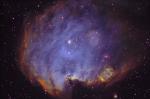 NGC 2174: Emission Nebula in Orion
8.12.2006
A lesser known sight in the nebula-rich constellation Orion, NGC 2174 can be found with binoculars near the head of the celestial hunter. About 6,400 light-years distant, the glowing cosmic cloud surrounds loose clusters of young stars.
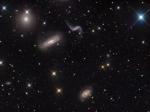 Galaxy Group Hickson 44
19.03.2007
Galaxies, like stars, frequently form groups. A group of galaxies is a system containing more than two galaxies but less than the tens or hundreds typically found in a cluster of galaxies. A most...
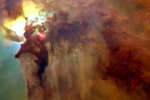 In the Center of the Lagoon Nebula
19.10.2008
The center of the Lagoon Nebula is a whirlwind of spectacular star formation. Visible on the upper left, at least two long funnel-shaped clouds, each roughly half a light-year long, have been formed by extreme stellar winds and intense energetic starlight. The tremendously bright nearby star, Hershel 36, lights the area.
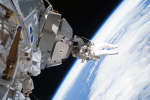 Astronaut Installs Panoramic Space Window
24.02.2010
This space job was almost complete. Floating just below the International Space Station, astronaut Nicholas Patrick put some finishing touches on the newly installed cupola space windows last week. Patrick was a mission specialist onboard the recently completed space shuttle Endeavor's STS-130 mission to the ISS.
 The View from Chajnantor
23.11.2011
From an altitude of over 5,000 meters, the night sky view from Chajnantor Plateau in the Chilean Andes is breathtaking in more ways than one. The dark site's rarefied atmosphere, at about 50 percent sea level pressure, is also extremely dry.
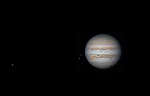 Jupiter s Triple Shadow Transit
2.11.2013
This webcam and telescope image of banded gas giant Jupiter shows the transit of three shadows cast by Jupiter's moons in progress, captured in Belgian skies on October 12 at 0528 UT. Such a three shadow transit is a relatively rare event, even for a large planet with many moons.
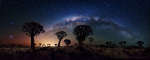 Milky Way Over Quiver Tree Forest
15.05.2016
In front of a famous background of stars and galaxies lies some of Earth's more unusual trees. Known as quiver trees, they are actually succulent aloe plants that can grow to tree-like proportions. The quiver tree name is derived from the historical usefulness of their hollowed branches as dart holders.
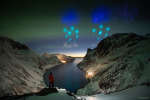 AZURE Vapor Tracers over Norway
8.04.2019
What's happening in the sky? The atmosphere over northern Norway appeared quite strange for about 30 minutes last Friday when colorful clouds, dots, and plumes suddenly appeared. The colors were actually created by the NASA-funded Auroral Zone Upwelling Rocket Experiment (AZURE) which dispersed gas tracers to probe winds in Earth's upper atmosphere.
|
January February March April May June July August September October |
|||||||||||||||||||||||||||||||||||||||||||||||||