
|
You entered: nearest stars
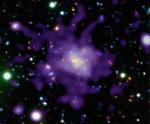 Galaxy Cluster in the Early Universe
26.02.2004
Long before medieval alchemists dreamed of transmuting base metals to gold, stellar furnaces in this massive cluster of galaxies - cataloged as RDCS 1252.9-2927 - had transformed light elements into heavy ones. In the false-color composite image individual cluster galaxies can be seen at optical and near-infrared wavelengths, shown in red, yellow, and green colors.
 Two Worlds One Sun
12.05.2015
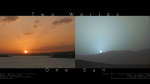
How different does sunset appear from Mars than from Earth? For comparison, two images of our common star were taken at sunset, one from Earth and one from Mars. These images were scaled to have same angular width and featured here side-by-side.
 APOD: 2020 August 2 Б Two Worlds One Sun
2.08.2020
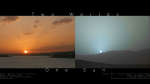
How different does sunset appear from Mars than from Earth? For comparison, two images of our common star were taken at sunset, one from Earth and one from Mars. These images were scaled to have same angular width and featured here side-by-side.
 APOD: 2026 January 26 Б NGC 55: A Galaxy of Nebulas
26.01.2026
Can you see nebulas in other galaxies? Yes, some nebulas shine brightly enough -- if you know how to look. Clouds of hydrogen and oxygen emit light at very specific colors, and by isolating them, astronomers and astrophotographers can reveal structures that would otherwise be too faint to notice.
 The High Energy Heart Of The Milky Way
29.07.1998
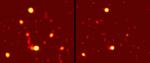
These high resolution false color pictures of the Galactic center region in high energy X-ray and gamma-ray light result from a very long exposure of roughly 3,000 hours performed from 1990 to 1997 by the French SIGMA telescope onboard the Russian GRANAT spacecraft.
 Three Dusty Stars
23.04.1998
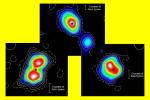
These separate radio images reveal three dusty debris disks surrounding three bright, young, nearby stars - evidence for solar systems in formation. From left to right are the stars Fomalhaut, Beta Pictoris, and Vega, their positions indicated by star symbols. The false color maps show the intensity of submillimeter radio emission from the surrounding dust.
 Meteor and Milky Way over the Alps
14.01.2019
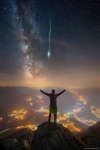
Now this was a view with a thrill. From Mount Tschirgant in the Alps, you can see not only nearby towns and distant Tyrolean peaks, but also, weather permitting, stars, nebulas, and the band of the Milky Way Galaxy.
 A Superior Conjunction Of Mercury
8.09.1999
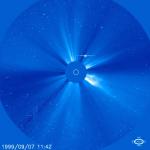
In astronomical parlance, an interior planet is at superior conjunction when it is located on the opposite side of the Sun from Earth. Mercury, the solar system's innermost planet, zips past this point in its orbit today.
 Cone Nebula Infrared Close Up
6.06.2002
After astronauts repaired NICMOS - the Near Infrared Camera and Multi-Object Spectrometer - during the latest Hubble Space Telescope servicing mission, astronomers were quick to turn the sophisticated instrument on the photogenic stellar nursery known as the Cone Nebula.
 APOD: 2025 June 15 Б Two Worlds One Sun
15.06.2025
How different does sunset appear from Mars than from Earth? For comparison, two images of our common star were taken at sunset, one from Earth and one from Mars. These images were scaled to have the same angular width and are featured here side-by-side.
|
January February March April May June July August September |
|||||||||||||||||||||||||||||||||||||||||||||||||