
|
You entered: Sun
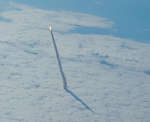 Space Shuttle Rising
23.05.2015
What's that rising from the clouds? The space shuttle. Sometimes, if you looked out the window of an airplane at just the right place and time, you could have seen something very unusual -- a space shuttle launching to orbit.
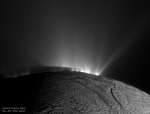 Life Enabling Plumes above Enceladus
15.04.2017
Does Enceladus have underground oceans that could support life? The discovery of jets spewing water vapor and ice was detected by the Saturn-orbiting Cassini spacecraft in 2005. The origin of the water feeding the jets, however, was originally unknown.
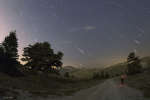 Perseid Meteors over Turkey
31.07.2017
The Perseid Meteor Shower, usually the best meteor shower of the year, will peak late next week. A person watching a clear sky from a dark location might see a bright meteor every minute.
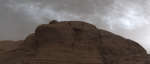 The Shining Clouds of Mars
4.06.2021
The weathered and layered face of Mount Mercou looms in the foreground of this mosaic from the Curiosity Mars rover's Mast Camera. Made up of 21 individual images the scene was recorded just after sunset on March 19, the 3,063rd martian day of Curiosity's on going exploration of the Red Planet.
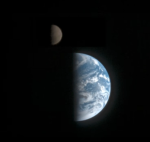 Earth and Moon
4.09.2021
The Earth and Moon are rarely photographed together. One of most spectacular times this occurred was about 30 years ago when the Jupiter-bound Galileo spacecraft zoomed past our home planetary system. Then, robotic Galileo watched from about 15-times the Earth-Moon separation as our only natural satellite glided past our home world.
 APOD: 2023 November 14 Б Three Planets Rock
13.11.2023
In the fading darkness before dawn, a tilted triangle appeared to balance atop a rock formation off the southern tip of Sicily. Making up the points of the triangle are three of the four brightest objects visible in EarthБs sky: Jupiter, Venus and the Moon.
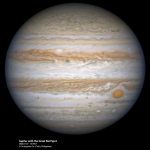 Jupiter with the Great Red Spot
9.01.2026
Jupiter reaches its 2026 opposition today, January 10. That puts our Solar System's most massive planet opposite the Sun and near its closest and brightest for viewing from planet Earth. In fact, captured...
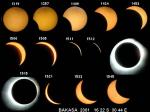 Bakasa Eclipse Sequence
6.07.2001
Starting at the upper left, this sequence of images follows the progress of the magnificent 21 June, 2001 solar eclipse in the clear skies over Bakasa, Zimbabwe. These pictures were recorded using a small reflecting telescope and digital camera with the approximate local time given above each frame.
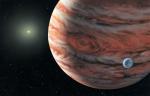 55 Cancri: Familiar Planet Discovered
14.06.2002
Is our Solar System unique? The discovery of a Jupiter-like planet in a Jupiter-like orbit around nearby Sun-like star 55 Cancri, announced yesterday, gives a new indication that planetary systems similar to our Solar System likely exist elsewhere. The planet, discovered by G.
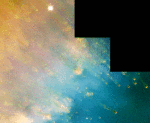 At the Edge of the Helix
22.04.1996
While exploring the inner edge of the Helix Nebula with the Hubble Space Telescope's Wide Field Planetary Camera 2, astronomers were able to produce this striking image - rich in details of an exotic environment.
|
January February March April May June July August September October |
|||||||||||||||||||||||||||||||||||||||||||||||||