
|
You entered: Andromeda
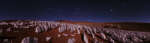 Night in the Andes Ice Forest
7.09.2013
This forest of snow and ice penitentes reflects moonlight shinning across the Chajnantor plateau. The region lies in the Chilean Andes at an altitude of 5,000 meters, not far from one of planet Earth's major astronomical observatories, the Atacama Large Millimeter/submillimeter Array.
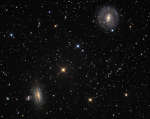 NGC 5078 and Friends
24.05.2016
This sharp telescopic field of view holds two bright galaxies. Barred spiral NGC 5101 (top right) and nearly edge-on system NGC 5078 are separated on the sky by about 0.5 degrees or about the apparent width of a full moon.
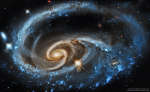 UGC 1810: Wildly Interacting Galaxy from Hubble
9.05.2017
What's happening to this spiral galaxy? Although details remain uncertain, it surely has to do with an ongoing battle with its smaller galactic neighbor. The featured galaxy is labelled UGC 1810 by itself, but together with its collisional partner is known as Arp 273.
 M32: Blue Stars in an Elliptical Galaxy
2.11.1999
Elliptical galaxies are known for their old, red stars. But is this old elliptical up to new tricks? In recent years, the centers of elliptical galaxies have been found to emit unexpectedly high amounts of blue and ultraviolet light.
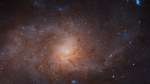 The Stars of the Triangulum Galaxy
22.02.2019
Like grains of sand on a cosmic beach, stars of the Triangulum Galaxy are resolved in this sharp mosaic from the Hubble Space Telescope's Advanced Camera for Surveys (ACS). The inner region of the galaxy spanning over 17,000 light-years is covered at extreme resolution, the second largest image ever released by Hubble.
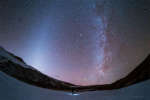 Dueling Bands in the Night
28.02.2022
What are these two bands in the sky? The more commonly seen band is the one on the right and is the central band of our Milky Way galaxy. Our Sun orbits...
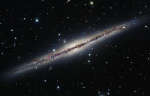 At the Edge of NGC 891
26.05.2012
This sharp cosmic portrait features NGC 891. The spiral galaxy spans about 100 thousand light-years and is seen almost exactly edge-on from our perspective. In fact, about 30 million light-years distant in the constellation Andromeda, NGC 891 looks a lot like our Milky Way.
 APOD: 2023 December 27 Б Rainbow Aurora over Icelandic Waterfall
26.12.2023
Yes, but can your aurora do this? First, yes, auroras can look like rainbows even though they are completely different phenomena. Auroras are caused by Sun-created particles being channeled into Earth's atmosphere by Earth's magnetic field, and create colors by exciting atoms at different heights.
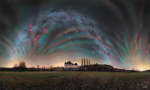 APOD: 2023 February 15 Б Airglow Sky over France
14.02.2023
This unusual sky was both familiar and unfamiliar. The photographer's mission was to capture the arch of the familiar central band of our Milky Way Galaxy over a picturesque medieval manor. The surprise was that on this January evening, the foreground sky was found glowing in a beautiful but unfamiliar manner.
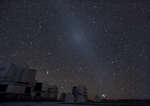 The Gegenschein Over Chile
2.12.2012
Is the night sky darkest in the direction opposite the Sun? No. In fact, a rarely discernable faint glow known as the gegenschein (German for "counter glow") can be seen 180 degrees around from the Sun in an extremely dark sky. The gegenschein is sunlight back-scattered off small interplanetary dust particles.
|
January February March April May June July August September October |
|||||||||||||||||||||||||||||||||||||||||||||||||