
|
You entered: Coma
 Meteors, Comet, and Big Dipper over La Palma
23.04.2019
Meteor showers are caused by streams of solid particles, dust size and larger, moving as a group through space. In most cases, the orbits of these meteor streams can be identified with dust expelled from a comet.
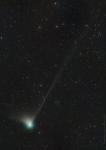 Comet 2022 E3 ZTF
24.12.2022
Comet C/2022 E3 (ZTF) was discovered by astronomers using the wide-field survey camera at the Zwicky Transient Facility this year in early March. Since then the new long-period comet has brightened substantially and is now sweeping across the northern constellation Corona Borealis in predawn skies.
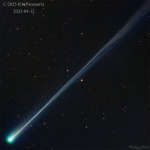 APOD: 2026 April 14 Б The Long Wispy Tail of Comet R3 (PanSTARRS)
14.04.2026
Why does Comet R3 (PanSTARRS) have a wispy tail? The newest bright member of the inner Solar System, Comet C/2025 R3 (PanSTARRS) is already extending an impressive stream of glowing gas. This tail starts from an unseen central nucleus of dirty ice that is likely a few kilometers across.
 Comet ISON Rising
27.11.2013
Will Comet ISON survive tomorrow's close encounter with the Sun? Approaching to within a solar diameter of the Sun's surface, the fate of one of the most unusual comets of modern times will finally be determined.
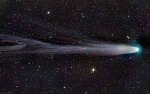 The Tail of a Christmas Comet
25.12.2021
The tail of a comet streams across this three degree wide telescopic field of view captured under dark Namibian skies on December 21. In outburst only a few days ago and just reaching naked eye visibility Comet Leonard (C/2021 A1) is this year's brightest comet.
 Comet 12P/Pons Brooks in Northern Spring
9.03.2024
As spring approaches for northern skygazers Comet 12P/Pons-Brooks is growing brighter. Currently visible with small telescopes and binoculars the Halley-type comet could reach naked eye visibility in the coming weeks. Seen despite a foggy...
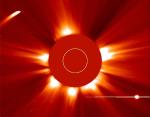 Sunbather
11.01.2002
Intense and overwhelming, the direct glare of the Sun is blocked by the smooth disk centered in this image from the sun-staring SOHO spacecraft. Taken on January 8, the picture shows streamers of solar wind billowing radially outward for millions of kilometers above the Sun's surface indicated by the white circle.
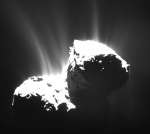 Jets from Comet Churyumov Gerasimenko
2.02.2015
Where do comet tails come from? Although it is common knowledge that comet tails and comas originate from comet nuclei, exactly how that happens is an active topic of research. One of the best...
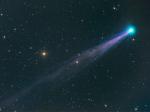 Comet SWAN Brightens
4.10.2006
A newly discovered comet has brightened enough to be visible this week with binoculars. The picturesque comet is already becoming a favored target for northern sky imagers. Pictured above just last week, Comet SWAN showed a bright blue-green coma and an impressive tail.
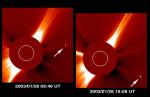 Comet Kudo-Fujikawa: Days in the Sun
30.01.2003
Cruising through the inner Solar System, new Comet Kudo-Fujikawa reached perihelion, its closest approach to the Sun, yesterday, January 29. Passing within 28.4 million kilometers of the Sun, this comet came much closer than innermost planet Mercury basking only 57.9 million kilometers from our parent star.
|
January February March April May June July August September October |
|||||||||||||||||||||||||||||||||||||||||||||||||