
|
You entered: merging galaxies
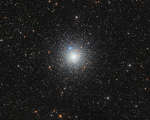 Globular Star Cluster NGC 6752
22.01.2020
Some 13,000 light-years away toward the southern constellation Pavo, the globular star cluster NGC 6752 roams the halo of our Milky Way galaxy. Over 10 billion years old, NGC 6752 follows clusters Omega Centauri and 47 Tucanae as the third brightest globular in planet Earth's night sky.
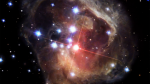 V838 Light Echo: The Movie
17.06.2014
What caused this outburst of V838 Mon? For reasons unknown, star V838 Mon suddenly became one of the brightest stars in the entire Milky Way Galaxy. Then, just a few months later, it faded.
 Globular Star Cluster NGC 6752
24.10.2024
Some 13,000 light-years away toward the southern constellation Pavo, the globular star cluster NGC 6752 roams the halo of our Milky Way galaxy. Over 10 billion years old, NGC 6752 follows clusters Omega Centauri, 47 Tucanae, and Messier 22 as the fourth brightest globular in planet Earth's night sky.
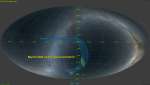 LIGO Virgo GW170814 Skymap
27.09.2017
From around planet Earth three gravitational wave detectors have now reported a joint detection of ripples in spacetime, the fourth announced detection of a binary black hole merger in the distant Universe. The event...
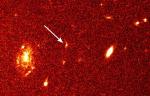 A Powerful Gamma Ray Burst
7.05.1998
Gamma-ray bursts are thought to be the most powerful explosions in the Universe, yet the cause of these high-energy flashes remains a mystery. Blindingly bright for space-based gamma-ray detectors the burst sources are so faint at visible wavelengths that large telescopes and sensitive cameras are required to search for them.
 M31 versus M33
26.09.2013
Separated by about 14 degrees (28 Full Moons) in planet Earth's sky, spiral galaxies M31 ,left, and M33 are both large members of the Local Group, along with our own Milky Way galaxy.
|
January February March April May June July |
|||||||||||||||||||||||||||||||||||||||||||||||||