
|
You entered: reflection nebula
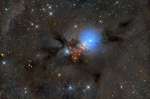 NGC 1333: Stellar Nursery in Perseus
5.11.2015
NGC 1333 is seen in visible light as a reflection nebula, dominated by bluish hues characteristic of starlight reflected by interstellar dust. A mere 1,000 light-years distant toward the heroic constellation Perseus, it lies at the edge of a large, star-forming molecular cloud.
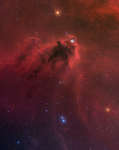 LDN 1622: Dark Nebula in Orion
21.02.2020
The silhouette of an intriguing dark nebula inhabits this cosmic scene. Lynds' Dark Nebula (LDN) 1622 appears against a faint background of glowing hydrogen gas only visible in long telescopic exposures of the region. In contrast, the brighter reflection nebula vdB 62 is more easily seen, just above and right of center.
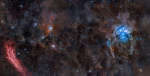 Seven Sisters Versus California
3.11.2009
On the upper right, dressed in blue, is the Pleiades. Also known as the Seven Sisters and M45, the Pleiades is one of the brightest and most easily visible open clusters on the sky. The Pleiades contains over 3,000 stars, is about 400 light years away, and only 13 light years across.
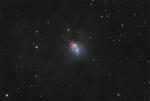 Dusty NGC 1300
6.10.2006
Dusty NGC 1333 is seen in visible light as a reflection nebula, dominated by bluish hues characteristic of starlight reflected by dust. But at longer infrared wavelengths, the interstellar dust itself glows. Moving your...
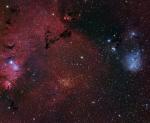 The Cone Nebula Neighborhood
12.04.2007
Cosmic clouds of hydrogen gas and dust abound in this gorgeous skyscape, stretching through Monocerous in the neighborhood of The Cone Nebula. A dark, obscuring dust cloud, the simple, sculpted shape of the Cone Nebula is near the lower left edge.
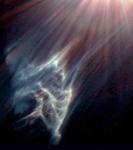 Reflecting Merope
6.12.2000
In the famous Pleiades star cluster, a star's light is slowly destroying a passing cloud of gas and dust. The star, Merope, lies just off the upper right edge of this recently released picture by the Hubble Space Telescope.
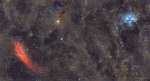 Seven Sisters versus California
5.04.2022
On the upper right, dressed in blue, is the Pleiades. Also known as the Seven Sisters and M45, the Pleiades is one of the brightest and most easily visible open clusters on the sky. The Pleiades contains over 3,000 stars, is about 400 light years away, and only 13 light years across.
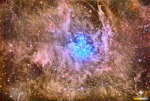 The Pleiades Deep and Dusty
14.11.2017
The well-known Pleiades star cluster is slowly destroying part of a passing cloud of gas and dust. The Pleiades is the brightest open cluster of stars on Earth's sky and can be seen from almost any northerly location with the unaided eye.
 Dark Markings of the Sky
25.04.2009
Based on wide field photographs, American astronomer Edward Emerson Barnard cataloged the dark markings of the sky in the early 20th century. Barnard's markings are dark nebulae, interstellar clouds of obscuring gas and dust.
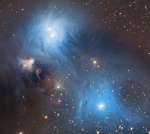 Stars and Dust in Corona Australis
18.10.2017
Blue dust clouds and young, energetic stars inhabit this telescopic vista, less than 500 light-years away toward the northern boundary of Corona Australis, the Southern Crown. The dust clouds effectively block light from more distant background stars in the Milky Way.
|
January February March April May June July August September |
|||||||||||||||||||||||||||||||||||||||||||||||||