
|
You entered: gas
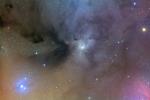 IC 4603: Reflection Nebula in Ophiuchius
4.06.2007
Why does this starfield photograph resemble an impressionistic painting? The effect is created not by digital trickery but by large amounts of interstellar dust. Dust, minute globs rich in carbon and similar in size to cigarette smoke, frequently starts in the outer atmospheres of large, cool, young stars.
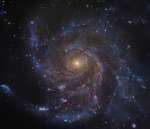 Messier 101
15.04.2011
Big, beautiful spiral galaxy M101 is one of the last entries in Charles Messier's famous catalog, but definitely not one of the least. About 170,000 light-years across, this galaxy is enormous, almost twice the size of our own Milky Way galaxy.
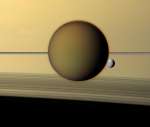 Ringside with Titan and Dione
5.01.2012
Orbiting in the plane of Saturn's rings, Saturnian moons have a perpetual ringside view of the gorgeous gas giant planet. Of course, while passing near the ring plane the Cassini spacecraft also shares their stunning perspective.
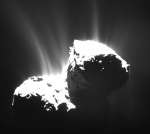 Jets from Comet Churyumov Gerasimenko
2.02.2015
Where do comet tails come from? Although it is common knowledge that comet tails and comas originate from comet nuclei, exactly how that happens is an active topic of research. One of the best...
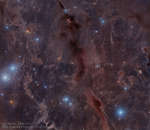 Dark Nebulas across Taurus
14.03.2016
Sometimes even the dark dust of interstellar space has a serene beauty. One such place occurs toward the constellation of Taurus. The filaments featured here can be found on the sky between the Pleiades star cluster and the California Nebula.
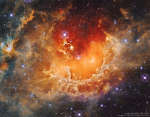 Star Formation in the Tadpole Nebula
7.05.2017
What's all of the commotion in the Tadpole nebula? Star formation. Dusty emission in the Tadpole nebula, IC 410, lies about 12,000 light-years away in the northern constellation of the Charioteer (Auriga).
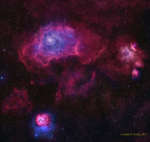 A Sagittarius Triplet
27.07.2017
These three bright nebulae are often featured on telescopic tours of the constellation Sagittarius and the crowded starfields of the central Milky Way. In fact, 18th century cosmic tourist Charles Messier cataloged two of them; M8, the large nebula above and left of center, and colorful M20 near the bottom of the frame.
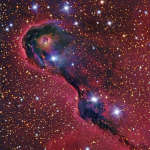 An Elephant s Trunk in Cepheus
16.01.2018
With image data from telescopes large and small, this close-up features the dusty Elephant's Trunk Nebula. It winds through the emission nebula and young star cluster complex IC 1396, in the high and far off constellation of Cepheus. Also known as vdB 142, the cosmic elephant's trunk is over 20 light-years long.
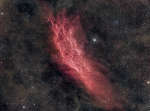 NGC 1499: The California Nebula
22.10.2022
Drifting through the Orion Arm of the spiral Milky Way Galaxy, this cosmic cloud by chance echoes the outline of California on the west coast of the United States. Our own Sun also lies within the Milky Way's Orion Arm, only about 1,500 light-years from the California Nebula.
 APOD: 2023 April 16 Б M2 9: Wings of a Butterfly Nebula
16.04.2023
Are stars better appreciated for their art after they die? Actually, stars usually create their most artistic displays as they die. In the case of low-mass stars like our Sun and M2-9 pictured here, the stars transform themselves from normal stars to white dwarfs by casting off their outer gaseous envelopes.
|
January February March April May June July August September October |
|||||||||||||||||||||||||||||||||||||||||||||||||