
|
You entered: constellation
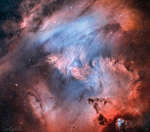 Wide Field: Fox Fur, Unicorn, and Christmas Tree
9.03.2020
What do the following things have in common: a cone, the fur of a fox, and a Christmas tree? Answer: they all occur in the constellation of the unicorn (Monoceros). Pictured as a star...
 Pleiades: The Seven Sisters Star Cluster
23.11.2021
Have you ever seen the Pleiades star cluster? Even if you have, you probably have never seen it as large and clear as this. Perhaps the most famous star cluster on the sky, the bright stars of the Pleiades can be seen without binoculars from even the depths of a light-polluted city.
 Thors Helmet
19.12.2022
Thor not only has his own day (Thursday), but a helmet in the heavens. Popularly called Thor's Helmet, NGC 2359 is a hat-shaped cosmic cloud with wing-like appendages. Heroically sized even for a Norse god, Thor's Helmet is about 30 light-years across.
 The Snows of Churyumov Gerasimenko
5.01.2024
You couldn't really be caught in this blizzard while standing by a cliff on periodic comet 67P/Churyumov-Gerasimenko. Orbiting the comet in June of 2016, the Rosetta spacecraft's narrow angle camera did record...
 NGC 253: Dusty Island Universe
14.02.2024
Shiny NGC 253 is one of the brightest spiral galaxies visible, and also one of the dustiest. Some call it the Silver Coin Galaxy for its appearance in small telescopes, or just the Sculptor Galaxy for its location within the boundaries of the southern constellation Sculptor.
 Pandora's Cluster of Galaxies
7.06.2024
This deep field mosaicked image presents a stunning view of galaxy cluster Abell 2744 recorded by the James Webb Space Telescope's NIRCam. Also dubbed Pandora's Cluster, Abell 2744 itself appears to be a ponderous merger of three different massive galaxy clusters. It lies some 3.5 billion light-years away, toward the constellation Sculptor.
 APOD: 2025 August 28 Б Galaxies, Stars, and Dust
27.08.2025
This well-composed telescopic field of view covers over a Full Moon on the sky toward the high-flying constellation Pegasus. Of course the brighter stars show diffraction spikes, the commonly seen effect of internal supports in reflecting telescopes, and lie well within our own Milky Way galaxy.
 Galaxies in the Furnace
3.12.2025
An example of violence on a cosmic scale, enormous elliptical galaxy NGC 1316 lies about 75 million light-years away toward Fornax, the southern constellation of the Furnace. Investigating the startling sight, astronomers suspect...
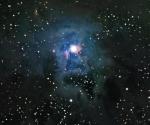 NGC 7023: The Iris Nebula
13.12.2001
Like delicate cosmic petals, these clouds of interstellar dust and gas have blossomed 1,300 light-years away in the fertile star fields of the constellation Cepheus. Sometimes called the Iris Nebula and dutifully cataloged as NGC 7023, this is not the only nebula in the sky to evoke the imagery of flowers.
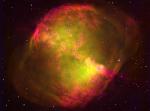 The Dumbbell Nebula in Hydrogen and Oxygen
12.01.2003
The first hint of what will become of our Sun was discovered inadvertently in 1764. At that time, Charles Messier was compiling a list of "annoying" diffuse objects not to be confused with "interesting" comets.
|
January February March April May June July August September October |
|||||||||||||||||||||||||||||||||||||||||||||||||