
|
You entered: sky
 Lynds Dark Nebula 1251
21.06.2024
Stars are forming in Lynds Dark Nebula (LDN) 1251. About 1,000 light-years away and drifting above the plane of our Milky Way galaxy, LDN 1251 is also less appetizingly known as "The Rotten Fish Nebula." The dusty molecular cloud is part of a complex of dark nebulae mapped toward the Cepheus flare region.
 APOD: 2024 August 27 Б Moon Eclipses Saturn
26.08.2024
What if Saturn disappeared? Sometimes, it does. It doesn't really go away, though, it just disappears from view when our Moon moves in front. Such a Saturnian eclipse, more formally called an occultation, was visible along a long swath of Earth -- from Peru, across the Atlantic Ocean, to Italy -- only a few days ago.
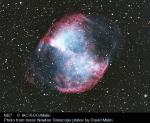 M27: The Dumbbell Nebula
17.02.1998
The first hint of what will become of our Sun was discovered inadvertently in 1764. At that time, Charles Messier was compiling a list of "annoying" diffuse objects not to be confused with "interesting" comets.
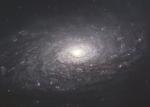 M63: The Sunflower Galaxy
27.06.2000
One of the bright spiral galaxies visible in the north sky is M63, the Sunflower Galaxy. M63, also catalogued as NGC 5055, can be found with a small telescope in the constellation of Canes Venaciti.
 A Slice of the Universe with 2dF
14.06.2000
What can 100,000 galaxies tell you? Perhaps the structure and composition of the universe. Astronomers using the Two Degree Field (2dF) spectrograph on the Anglo-Australian Telescope (AAT) in Australia have now measured the redshifts of over 100,000 galaxies in a thin ribbon of the sky.
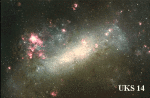 The Large Cloud of Magellan
18.09.1995
Magellan and his crew had plenty of time to study the southern sky during their famous voyage around the world. As a result, two fuzzy cloud like objects, nestled among the southern constellations of Doradus and Tucana are now known as the Clouds of Magellan.
 Releasing Compton
28.11.1995
Named for Nobel laureate physicist Arthur Holly Compton, the Compton Gamma Ray Observatory (CGRO) Satellite was launched in April of 1991 aboard the Space Shuttle Atlantis. CGRO's mission is to explore the Universe at gamma-ray energies.
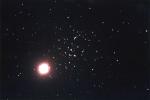 Jupiter in the Hive
3.04.2003
If you can find planet Jupiter in tonight's sky, then you can also find M44, popularly known as the Beehive star cluster. In fact, with a pair of binoculars most casual skygazers should find it easy to zero in on this celestial scene.
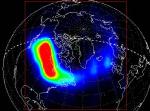 Solar Storm Causes X-Ray Aurora
18.04.1997
On April 7, the SOHO spacecraft spotted a Solar Storm ejecting a cloud of energetic particles toward planet Earth. The plasma cloud's center missed Earth, but high energy particles swept up by Earth's magnetosphere still created a geomagnetic storm!
 A Panorama from Mauna Kea
4.07.2005
Typically, views from Mauna Kea are up and dark. That's because the famous dormant volcano in Hawaii is arguably Earth's premier observing platform of the complex and ever changing night sky. However, this daytime view is across and bright. White snow and white clouds seem to blend together to make an alien landscape.
|
January February March April May June July August September October |
|||||||||||||||||||||||||||||||||||||||||||||||||