
|
You entered: image
 Total Solar Eclipse Below the Bottom of the World
5.12.2021
Yesterday there was a total solar eclipse visible only at the end of the Earth. To capture the unusual phenomenon, airplanes took flight below the clouded seascape of Southern Ocean. The featured image shows...
 Galaxy Cluster Abell 370 and Beyond
12.09.2023
Some 4 billion light-years away, massive galaxy cluster Abell 370 is captured in this sharp Hubble Space Telescope snapshot. The cluster of galaxies only appears to be dominated by two giant elliptical galaxies and infested with faint arcs.
 APOD: 2025 April 29 Б Saturns Rings Appear to Disappear
29.04.2025
Where are Saturn's ears? Galileo is credited, in 1610, as the first person to see Saturn's rings. Testing out Lipperhey's recently co-invented telescope, Galileo did not know what they were and so called them "ears". The mystery deepened in 1612, when Saturn's ears mysteriously disappeared.
 The Bubble Nebula
2.09.2010
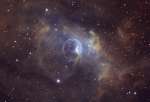
Blown by the wind from a massive star, this interstellar apparition has a surprisingly familiar shape. Cataloged as NGC 7635, it is also known simply as The Bubble Nebula. Although it looks delicate, the 10 light-year diameter bubble offers evidence of violent processes at work.
 Draconid Meteors Over Spain
19.10.2011
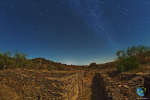
What are those streaks in the sky? They're meteors from the Draconids meteor shower that peaked earlier this month. The above composite image captured numerous meteor streaks over 90 minutes above the Celtic ruins of Capote in Badajoz province, Spain.
 Methone: Smooth Egg Moon of Saturn
6.11.2012
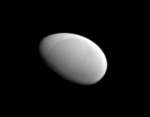
Why is this moon shaped like a smooth egg? The robotic Cassini spacecraft completed the first flyby ever of Saturn's small moon Methone in May and discovered that the moon has no obvious craters.
 Star Forming Region NGC 3582
11.06.2013
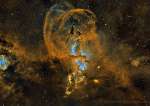
What's happening in the NGC 3582 nebula? Bright stars and interesting molecules are forming. The complex nebula resides in the star forming region called RCW 57. Visible in this image are dense knots...
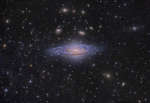 NGC 7331 and Beyond
17.12.2014
Big, beautiful spiral galaxy NGC 7331 is often touted as an analog to our own Milky Way. About 50 million light-years distant in the northern constellation Pegasus, NGC 7331 was recognized early on as a spiral nebula and is actually one of the brighter galaxies not included in Charles Messier's famous 18th century catalog.
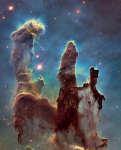 Hubble 25th Anniversary: Pillars of Creation
6.01.2015
To celebrate 25 years (1990-2015) of exploring the Universe from low Earth orbit, the Hubble Space Telescope's cameras were used to revisit its most iconic image. The result is this sharper, wider view of the region dubbed the Pillars of Creation, first imaged by Hubble in 1995.
 Detailed View of a Solar Eclipse Corona
13.08.2017
Only in the fleeting darkness of a total solar eclipse is the light of the solar corona easily visible. Normally overwhelmed by the bright solar disk, the expansive corona, the sun's outer atmosphere, is an alluring sight.
|
January February March April May June July August September |
|||||||||||||||||||||||||||||||||||||||||||||||||