
|
You entered: nearest stars
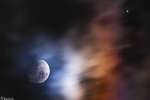 APOD: 2020 September 2 Б Jupiter and the Moons
2.09.2020
How many moons do you see? Many people would say one, referring to the Earth's Moon, prominent on the lower left. But take a closer look at the object on the upper right.
 NGC 2736: The Pencil Nebula
15.07.2016
Moving from top to bottom in the frame near the center of this sharply detailed color composite, thin, bright, braided filaments are actually long ripples in a cosmic sheet of glowing gas seen almost edge-on. The shock wave plows through interstellar space at over 500,000 kilometers per hour.
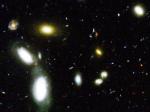 Galaxies in the GOODS
25.06.2003
This tantalizing view of galaxies scattered near and far is part of the Hubble Space Telescope's contribution to the GOODS - the Great Observatories Origins Deep Survey project. The GOODS' goal is to study...
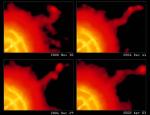 The Vela Pulsar s Dynamic Jet
3.07.2003
The Vela pulsar is a neutron star born over 10,000 years ago in a massive supernova explosion. Above, false-color x-ray images from the Chandra Observatory reveal details of this remnant pulsar's x-ray bright nebula along with emission from a spectacular jet of high-energy particles.
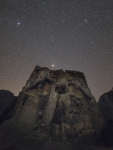 Mars, Pleiades, and Andromeda over Stone Lions
13.10.2020
Three very different -- and very famous -- objects were all captured in a single frame last month. On the upper left is the bright blue Pleiades, perhaps the most famous cluster of stars on the night sky. The Pleiades (M45) is about 450 light years away and easily found a few degrees from Orion.
 Time Tunnel
6.09.2007
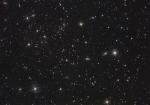
Spiky stars are nearby, but fuzzy galaxies are strewn far across the Universe in this cosmic view. Spanning about 1/2 degree on the sky, the pretty picture is the result of astronomer Johannes Schedler's project to look back in time, toward a quasar 12.7 billion light-years away.
 Comet over California
7.03.2008
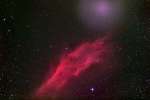
Still gracing northern skies, a fading Comet Holmes lies at the top edge of this colorful skyview, recorded on March 4. The reddish emission nebula below it is NGC 1499, also known as the California Nebula for its resemblance to the outline of the state on the US west coast.
 HUDF Infrared: Dawn of the Galaxies
9.12.2009
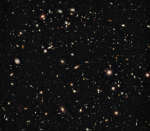
When did galaxies form? To help find out, the deepest near-infrared image of the sky ever has been taken of the same field as the optical-light Hubble Ultra Deep Field (HUDF) in 2004. The new image was taken this summer by the newly installed Wide Field Camera 3 on the refurbished Hubble Space Telescope.
 Views from Cassini at Saturn
13.06.2011
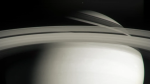
What has the Cassini orbiter seen since arriving at Saturn? The above music video shows some of the highlights. In the first time-lapse sequence (00:07), a vertical line appears that is really Saturn's thin rings seen nearly edge-on. Soon some of Saturn's moon shoot past.
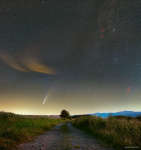 Comet NEOWISE and Nebulae
20.07.2020
Would you brave wild animals to photograph this sky? One astrophotographer did -- and we all get to reap the rewards. First, thousands of stars were visible with many of the brightest impressively blue. Next, several red-glowing nebulae were discernible, including the California Nebula on the far right, and, above it, the Heart and Soul nebulae.
|
January February March April May June July August September |
|||||||||||||||||||||||||||||||||||||||||||||||||