
|
You entered: Deep Sky
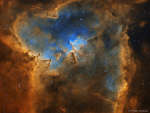 The Heart Nebula in Hydrogen, Oxygen, and Sulfur
27.08.2017
What powers the Heart Nebula? The large emission nebula dubbed IC 1805 looks, in whole, like a heart. The nebula's glow -- as well as the shape of the gas and dust clouds -- is powered by by stellar winds and radiation from massive hot stars in the nebula's newborn star cluster Melotte 15.
 Ice Fishing for Cosmic Neutrinos
3.08.2003
Scientists are melting holes in the bottom of the world. In fact, several holes have been melted near the South Pole, and they are now being used as astronomical observatories. Astronomers with the Antarctic Muon and Neutrino Detector Array (AMANDA) lower into each vertical lake a string knotted with basketball-sized light detectors.
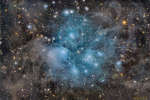 The Pleiades Deep and Dusty
25.02.2014
The well known Pleiades star cluster is slowly destroying part of a passing cloud of gas and dust. The Pleiades is the brightest open cluster of stars on Earth's sky and can be seen from almost any northerly location with the unaided eye.
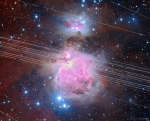 Starlink over Orion
1.06.2021
What are those streaks across Orion? Most are reflections of sunlight from numerous Earth-orbiting Starlink satellites. Appearing by eye as a series of successive points floating across a twilight sky, the increasing number of SpaceX Starlink communication satellites are causing concern among many astronomers.
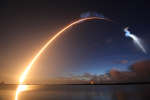 Atlas V Rising
5.09.2015
Early morning risers along Florida's Space Coast, planet Earth, were treated to a launch spectacle on September 2nd. Before dawn an Atlas V rocket rose into still dark skies carrying a US Navy communications satellite from Cape Canaveral Air Force Station into Earth orbit.
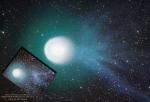 A Tale of Comet Holmes
10.11.2007
A beautiful blue ion tail has become visible in deep telescopic images of Comet Holmes. Pointing generally away from the Sun and also planet Earth, the comet's ion tail is seriously foreshortened by our extreme viewing angle.
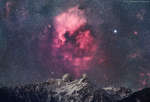 North American Nightscape
29.01.2021
On January 21, light from the Moon near first quarter illuminated the foreground in this snowy mountain and night scene. Known as The Lions, the striking pair of mountain peaks are north of Vancouver, British Colombia, Canada, North America, planet Earth.
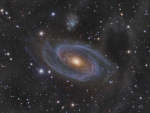 Grand Spiral Galaxy M81 and Arps Loop
16.04.2013
One of the brightest galaxies in planet Earth's sky is similar in size to our Milky Way Galaxy: big, beautiful M81. This grand spiral galaxy lies 11.8 million light-years away toward the northern constellation of the Great Bear (Ursa Major).
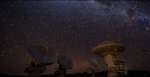 An ALMA Telescope Array Time Lapse
26.05.2014
It is the most expensive and complex ground-based astronomy project ever -- what will it see tonight? The Atacama Large Millimeter Array (ALMA) project consists of 66 dishes, many the size of a small house, situated in the high altitude Atacama Desert in Northern Chile.
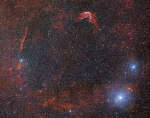 RCW 86: Historical Supernova Remnant
3.03.2023
In 185 AD, Chinese astronomers recorded the appearance of a new star in the Nanmen asterism. That part of the sky is identified with Alpha and Beta Centauri on modern star charts. The new star was visible to the naked-eye for months, and is now thought to be the earliest recorded supernova.
|
January February March April May June July August September |
|||||||||||||||||||||||||||||||||||||||||||||||||