
|
You entered: Earth's atmosphere
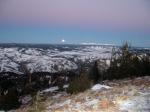 Shadow Set
4.02.2006
A nearly full Moon and planet Earth's shadow set together in this scene captured on January 13th from snowy Mt. Jelm, home of the Wyoming Infrared Observatory. For early morning risers (and late...
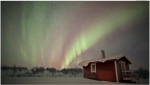 Trees, Stars, Aurora
9.02.2012
Have you ever seen an aurora? Auroras are occurring again with increasing frequency. With the Sun being unusually dormant over the past four years, the amount of Sun-induced auroras has been unusually low. More recently, however, our Sun has become increasingly active and exhibiting a greater abundance of sunspots, flares, and coronal mass ejections.
 Pic du Pleiades
9.12.2023
Near dawn on November 19 the Pleiades stood in still dark skies over the French Pyrenees. But just before sunrise a serendipitous moment was captured in this single 3 second exposure; a bright meteor streak appeared to pierce the heart of the galactic star cluster.
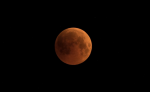 A Total Lunar Eclipse Video
20.01.2019
Tonight a bright full Moon will fade to red. Tonight's moon will be particularly bright because it is reaching its fully lit phase when it is relatively close to the Earth in its elliptical orbit.
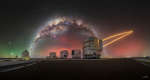 APOD: 2026 March 10 Б Sky Glows over Paranal Observatory
10.03.2026
Are lasers from giant telescopes being used to defend the Earth? No. Lasers shot from telescopes are now commonly used to help increase the accuracy of astronomical observations. In some directions, Earth atmosphere-induced fluctuations in starlight can indicate how the air mass over a telescope is changing, but in other directions, no bright star exists.
 HET: The New Largest Optical Telescope
27.12.1996
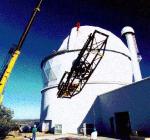
Most of our universe is too dim to see. To peer into our cosmos' unknown depths, astronomers must deploy new tools - and the classic new tool is a larger telescope. Pictured above is the new Hobby-Eberly Telescope (HET) which recently declared "first light" in western Texas.
 SuitSat1: A Spacesuit Floats Free
27.04.2014
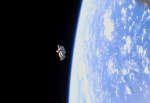
A spacesuit floated away from the International Space Station eight years ago, but no investigation was conducted. Everyone knew that it pushed by the space station crew. Dubbed Suitsat-1, the unneeded Russian Orlan spacesuit filled mostly with old clothes was fitted with a faint radio transmitter and released to orbit the Earth.
 Sundogs over the VLA
23.08.1999
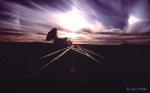
What if you woke up one morning and saw more than one Sun in the sky? Most probably, you would be seeing sundogs, extra-images of the Sun created by falling ice-crystals in the Earth's atmosphere. As water freezes in the atmosphere, small, flat, six-sided, ice crystals might be formed.
 SuitSat 1: A Spacesuit Floats Free
28.03.2021
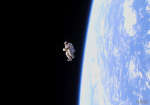
A spacesuit floated away from the International Space Station 15 years ago, but no investigation was conducted. Everyone knew that it was pushed by the space station crew. Dubbed Suitsat-1, the unneeded Russian Orlan spacesuit filled mostly with old clothes was fitted with a faint radio transmitter and released to orbit the Earth.
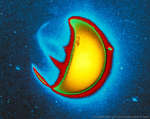 Ultraviolet Earth from an Observatory on the Moon
28.10.2018
Which planet is this? Earth. The featured false color picture shows how the Earth shines in ultraviolet (UV) light. The image is historic because it was taken from the surface of the Moon by humanity's only lunar observatory.
|
January February March April May June July August September October |
|||||||||||||||||||||||||||||||||||||||||||||||||