
|
You entered: atmosphere
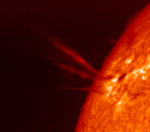 A Solar Corona Ejection
8.11.1996
The Sun would not be a nice place to spend the summer. One reason, besides the extreme heat, is that explosions are common there. In the above picture, magnetic fields buckle releasing previously constrained hot material from the upper atmosphere of the Sun.
 Strawberry Sun
29.08.2013
This striking, otherworldy scene really is a view from planet Earth. The ochre sky and strawberry red sun were photographed on August 22nd near the small village of Strawberry, California, USA. Found along Highway...
 Meteor over the Bay of Naples
17.02.2024
A cosmic dust grain plowing through the upper atmosphere much faster than a falling leaf created this brilliant meteor streak. In a serendipitous moment, the sublime night sky view was captured from the resort island of Capri, in the Bay of Naples, on the evening of February 8.
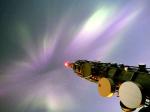 Aurora Over a Communications Tower
28.09.2004
Higher than highest communications tower, higher than highest mountain, higher than highest airplane, lies the realm of the aurora. Auroras rarely reach below 60 kilometers, and can range up to 1000 kilometers. Aurora light results from energetic electrons and protons striking molecules in the Earth's atmosphere.
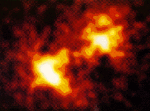 An X-ray Hot Supernova in M81
3.12.1995
In 1993, a star in the galaxy M81 exploded. Above is a picture of the hot material ejected by this supernova explosion. The picture was taken in X-rays with the Advanced Satellite for Cosmology and Astrophysics (ASCA).
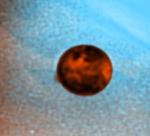 Eruption on Io
23.06.1997
There it goes again. Gas and rock were catapulted hundreds of kilometers into space as Jupiter's most volatile moon, Io, showed yet another impressive volcanic display in this just-released photograph by the Hubble Space Telescope.
 Fireball Meteor Over Groningen
15.10.2009
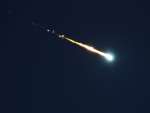
The brilliant fireball meteor captured in this snapshot was a startling visitor to Tuesday evening's twilight skies over the city of Groningen. In fact, sightings of the meteor, as bright as the Full Moon, were widely reported throughout the Netherlands and Germany at approximately 17:00 UT.
 Comet Impacts on Jupiter
14.07.1995
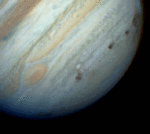
In July of 1994, pieces of Comet Shoemaker-Levy 9, also known as the "string of pearls" comet, collided with the planet Jupiter. As the comet fragments smashed in to Jupiter, the resulting explosions scattered large quantities of dusty cometary debris into the Jovian atmosphere.
 Welcome to Planet Earth
19.08.1996
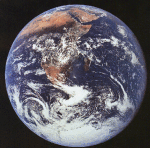
Welcome to Planet Earth, the third planet from a star named the Sun. The Earth is shaped like a sphere and composed mostly of rock. Over 70 percent of the Earth's surface is water. The planet has a relatively thin atmosphere composed mostly of nitrogen and oxygen.
 Rhea: Saturn's Second Largest Moon
8.06.2003
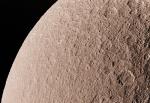
Rhea is the second largest moon of Saturn, behind Titan, and the largest without an atmosphere. It is composed mostly of water ice, but has a small rocky core. Rhea's rotation and orbit are locked together (just like Earth's Moon) so that one side always faces Saturn.
|
January February March April May June July August September October |
|||||||||||||||||||||||||||||||||||||||||||||||||