
|
You entered: dust disk
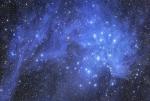 Pleiades and Stardust
22.11.2007
Hurtling through a cosmic dust cloud a mere 400 light-years away, the lovely Pleiades or Seven Sisters star cluster is well-known for its striking blue reflection nebulae. This remarkable wide-field (3 degree) image...
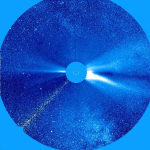 Solar Wind And Milky Way
4.03.1997
The Sun is bright, so bright that it overwhelms the light from other stars even for most satellite-borne telescopes. But LASCO, a coronograph onboard the space-based SOHO Observatory, uses occulting disks to block the intense solar light and examine the tenuous, hot gases millions of miles above the Sun's surface.
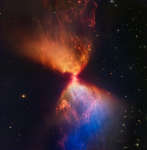 The Protostar within L1527
18.11.2022
The protostar within dark cloud L1527 is a mere 100,000 years old, still embedded in the cloud of gas and dust that feeds its growth. In this NIRCam image from the James Webb...
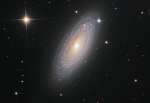 Spiral Galaxy NGC 2841
29.03.2008
Some 50 million light-years distant, spiral galaxy NGC 2841 can be found in the northern constellation of Ursa Major. This sharp view of the gorgeous island universe shows off a striking yellow nucleus and galactic disk with tightly wound spiral arms.
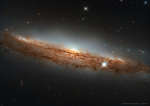 NGC 3717: A Nearly Sideways Spiral Galaxy
12.11.2019
Some spiral galaxies are seen nearly sideways. Most bright stars in spiral galaxies swirl around the center in a disk, and seen from the side, this disk can be appear quite thin. Some spiral galaxies appear even thinner than NGC 3717, which is actually seen tilted just a bit.
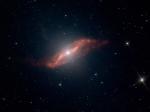 The Galaxy Within Centaurus A
4.03.2006
Peering deep inside Centaurus A, the closest active galaxy to Earth, the Spitzer Space Telescope's penetrating infrared cameras recorded this startling vista in February 2004. About 1,000 light-years across, the twisted cosmic...
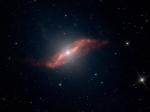 The Galaxy Within Centaurus A
24.06.2004
Peering deep inside Centaurus A, the closest active galaxy to Earth, the Spitzer Space Telescope's penetrating infrared cameras recorded this startling vista. About 1,000 light-years across, the twisted cosmic dust cloud apparently shaped like a parallelogram is likely the result of a smaller spiral galaxy falling into the giant Centaurus A.
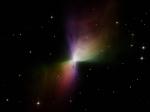 The Boomerang Nebula in Polarized Light
14.09.2005
Why did the Boomerang Nebula form? The symmetric cloud dubbed the Boomerang appears to have been created by a high-speed wind of gas and dust blowing from an aging central star at speeds of nearly 600,000 kilometers per hour.
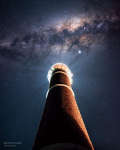 Milky Way over Uruguayan Lighthouse
19.11.2019
Can a lighthouse illuminate a galaxy? No, but in the featured image, gaps in light emanating from the Jose Ignacio Lighthouse in Uruguay appear to match up nicely, although only momentarily and coincidently, with dark dust lanes of our Milky Way Galaxy. The bright dot on the right is the planet Jupiter.
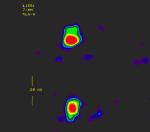 Twin Proto Planetary Disks
25.09.1998
Sun-like stars are forming - and probably planets too - hidden inside Lynds 1551, an interstellar cloud of molecular gas and dust in the constellation Taurus. Using new receivers, coordinated radio telescopes at the Very Large Array near Socorro, New Mexico, USA, can now sharply image the dusty proto-planetary disks surrounding these young stars at radio wavelengths.
|
January February March April May June July August |
||||||||||||||||||||||||||||||||||||||||||||||||||||||||